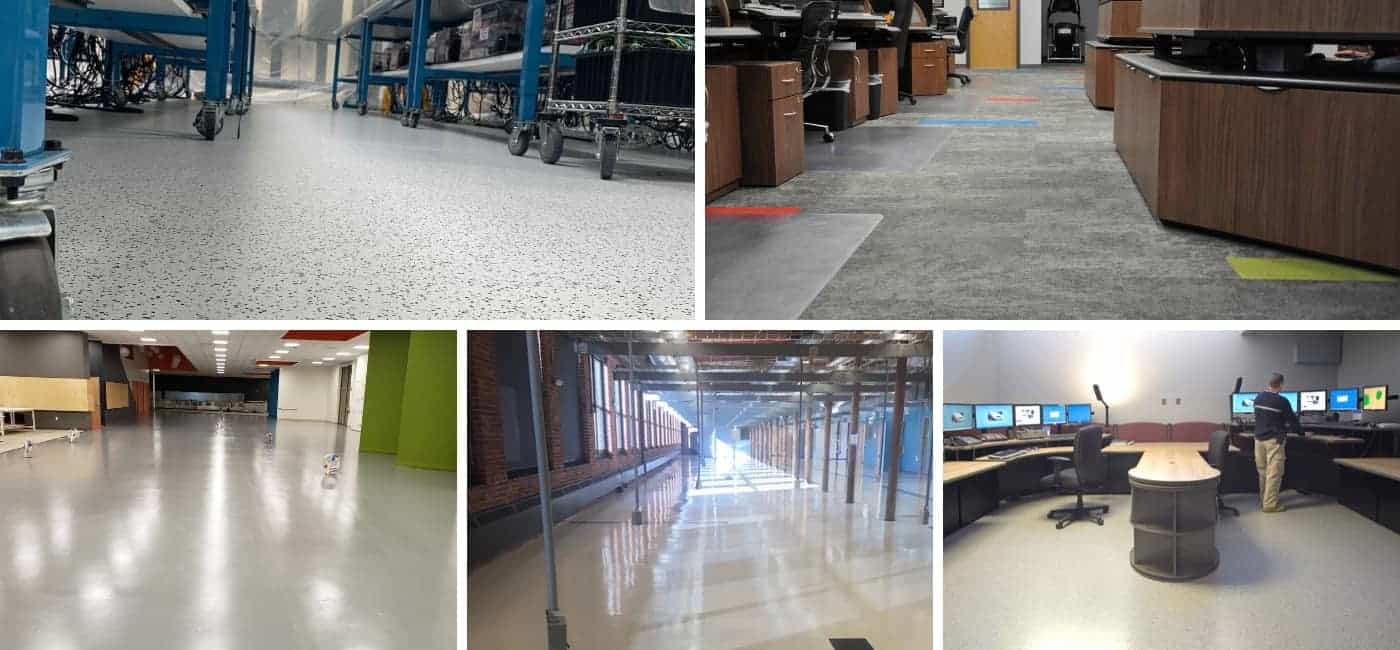
Electronics industry flooring applications—including electronics manufacturing facilities, microelectronics fabrication, circuit board assembly, box build, electronics test and repair, cleanrooms, labs and R&D facilities—have more stringent static-control requirements than do most other applications.
Electronic equipment with highly sensitive microcircuits is particularly susceptible to damage caused by the sudden spike in electrical current that results from random static discharge. The protocols set by the ESD Association, in their standard ANSI/ESD S20.20, were created for these spaces.
Choosing the Right ESD Floor
To prevent random static events, ESD floors—also known as antistatic floors or static-control floors—must perform two equally important functions:
- Provide personnel and equipment with a verifiable path to ground of less than or equal to 1 billion ohms (≤ 1.0 x 10E9);
- Prevent static charges in excess of 100 volts (< .1 kV) from accumulating as people walk (called walking body voltage).
ESD Standards

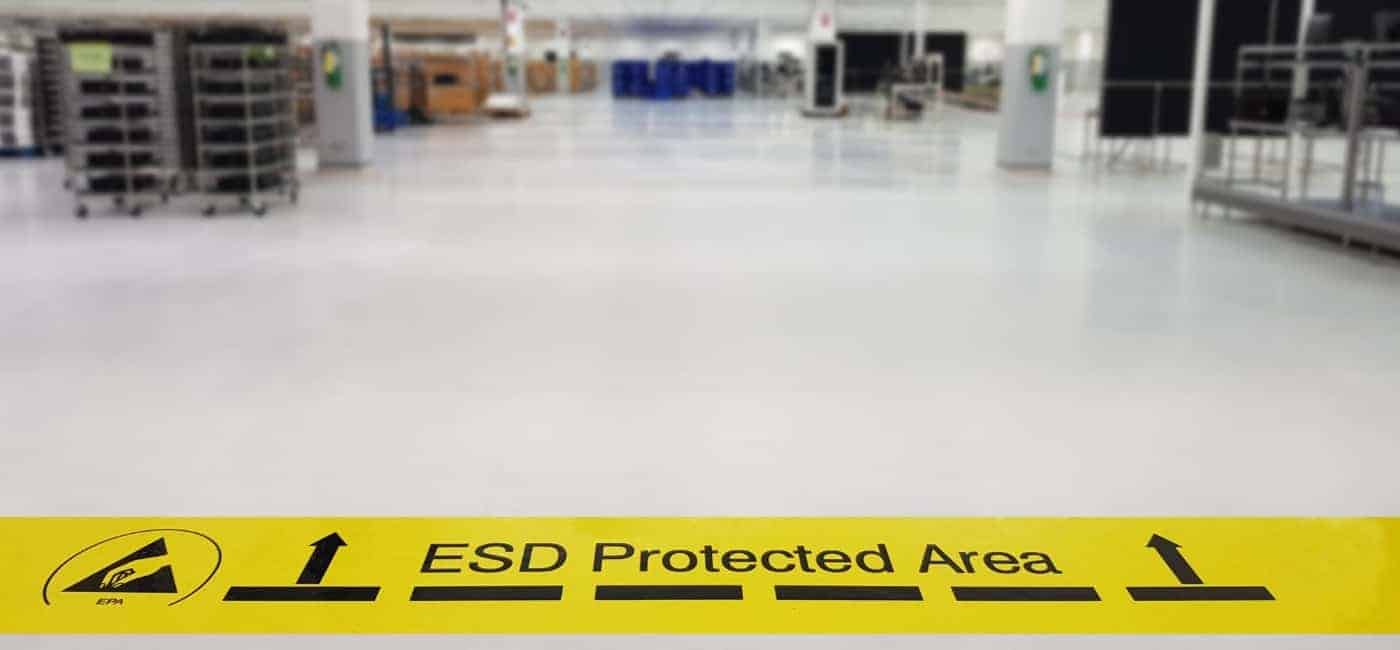
Electronics manufacturing and handling facilities adhere to ANSI/ESD S20.20. Note: S20.20 requires that all personnel within an ESD Protected Area (EPA)* use ESD-protective footwear – i.e., heel straps, toe straps, sole straps or ESD shoes. ESD footwear creates an electrical bond with conductive elements in ESD flooring, allowing for wider choice in ESD flooring materials.
EPA: “a defined location with the necessary materials, tools and equipment capable of controlling static electricity to a level that minimizes damage to ESD-susceptible items.”
ANSI/ESD S20.20
ESD Association Standard for the Development of an Electrostatic Discharge Control Program for Protection of Electrical and Electronic Parts, Assemblies and Equipment (Excluding Electrically Initiated Explosive Devices). This standard provides administrative and technical requirements for establishing, implementing and maintaining an ESD Control Program.
Electrical resistance of a flooring system (ANSI/ESD STM 7.1)
Point to Point: < 1.0 x 10E9 ohms
Point to Groundable Point: < 1.0 x 10E9 ohms
Resistance of Footwear/Flooring System (ANSI/ESD STM 97.1)
< 1.0 x 10E9 ohms
Floor Materials and Footwear Maximum Voltage in Combination with a Person (ANSI/ESD STM 97.2)
< 100 volts Peak
For fundamentals on electrostatic discharge and further information on ESD standards, see: Fundamentals of Electrostatic Discharge.
Class-0 Electronics
Class-0 Electronic Devices
Class 0: Although standards organizations have not fully defined the term ESD Class 0 for manufacturing programs, the classification is widely used within the electronics industry to represent ultra-sensitive devices. While most companies are acutely aware of the hazards of ESD (electrostatic discharge), few are aware of best practices for preventing failures of today’s extremely sensitive devices often referred to as Class 0.
Floors for Class 0 applications must satisfy electrical resistance requirements in ANSI/ESD S20.20 and generate less than 20 volts on a person wearing protective footwear in combination with ESD flooring.
Point to Point, Point to Groundable Point, and Footwear/Flooring System: < 1.0 x 10E9
Charge Generation: < 20 volts
IEC 61340-5-1*
From IECEE.ORG: Electrostatics – Part 5-1: Protection of electronic devices from electrostatic phenomena – General requirements.
The purpose of this standard is to provide the administrative and technical requirements for establishing, implementing and maintaining an ESD control program …This [updated] version of IEC 61340-5-1 has been aligned with other major ESD control program standards used throughout the world.
* IEC 61340-5-1 is the European equivalent to ANSI/ESD S20.20
Please note: ANSI/ESD S20.20 requires people working in these facilities to wear special ESD-protective footwear – i.e. heel straps, toe straps, sole straps, ESD shoes.
Applications
Applications include any facility that manufactures, packages, tests, repairs or handles high-speed electronic components.
- Computer and PCB Assembly
- Surface Mount Technology (SMT)
- Configuration and ESDS Device Handling
- Automated Assembly Areas
- Electronic Assembly Areas
- Automated Guided Vehicle Areas
- Surface Mount and Wave Solder Areas
- BGA Rework
- Box Build
- Wafer Fab
- Cleanrooms
- Labs
- Repair
Watch
Listen
The Pitfalls of ESD Flooring Selection: How to Avoid ESD Flooring Failure
Three fundamental mistakes account for a majority of ESD flooring failures: selecting the wrong floor for the application: failure to consider total cost of ownership; failing to test the floor after it’s been installed. Avoiding these mistakes helps ensure success. This first of a two-part series on avoiding ESD flooring failures explains why it’s important to select a floor based on the specific application and details the primary considerations that should be taken into account: assessing the type of footwear people will wear in the space and considering goals and objectives, including how the space will be used.
Installing ESD Flooring: Avoiding Pitfalls
The cost of flooring materials is only part of the total cost of ownership. To calculate the long-term cost of owning a floor, consider installation, maintenance, repairs, and downtime required for maintenance and repair. Aesthetics are another consideration. In this podcast, Dave and Rick describe scenarios that occur when people base flooring decisions solely on the cost of the material. Dave also explains why it’s crucial to test an ESD floor immediately after it’s been installed.