
NFPA 99 No Longer Covers Conductive Flooring
You may have heard ESD flooring manufacturers refer to a standard called NFPA 99. With roots dating back to the 1950s, NFPA 99 guides health care services in minimizing the hazards of fire, explosion, and electricity in their facilities.
In 2015, the NFPA removed conductive flooring from the standard. But let’s forget for a moment that, for ESD flooring, NFPA 99 is defunct.
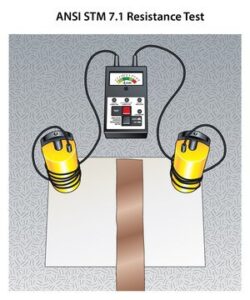
To meet the NFPA standard, the electrical resistance of an ESD floor had to measure no less than 2.5 x 10E4, or 25,000 ohms. The resistance test for NFPA 99 is similar to ANSI/ESD Standard Test Method (STM) 7.1. Both tests measure electrical resistance—or a floor’s capacity to resist, or reduce, electrical current.
Neither test reliably simulates a real-world environment: Both use a battery-operated generator to apply voltage across the surface of the flooring material. Battery-operated generators put out direct, or D-C, current, which flows in one direction. The electricity in common power circuits travels in waves, or A-C, alternating current, which periodically changes or reverses direction.
An independent engineering lab tested the resistance of ESD floors using both A-C and D-C currents. Delivered across an ESD floor, A-C currents measured as much as nine times higher than predicted by theoretical calculations based on Ohm’s Law.
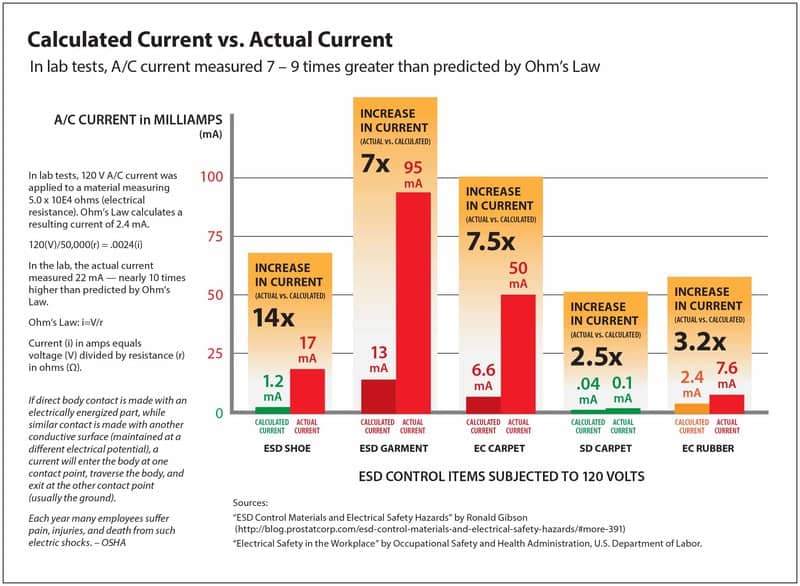

This means, in a real-world environment, electricity will flow across the floor far faster than predicted mathematically. That’s why, when selecting any ESD floor, it’s crucial to consider safety.
It’s also why the FAA (in FAA 019f) prohibits conductive flooring that measures under 1 x 10E6—anyplace where personnel may come into contact with energized equipment. In layman’s terms: anywhere electronics are plugged into an outlet.
Resistance Testing: NFPA 99 and ANSI/ESD 7.1
While NFPA 99 and ANSI/ESD 7.1 were similar tests, they differed in one very important way: The test for NFPA 99 was done with 500 volts of electricity. ESD 7.1 is done with only 10 volts. 10. That’s 1 fiftieth the voltage used in NFPA 99.
Why does it matter?
Because some people assume the readings are interchangeable—and they’re not. According to Ohm’s Law, voltage correlates inversely to electrical resistance. Put simply: less applied voltage yields a higher resistance reading. And vice versa.
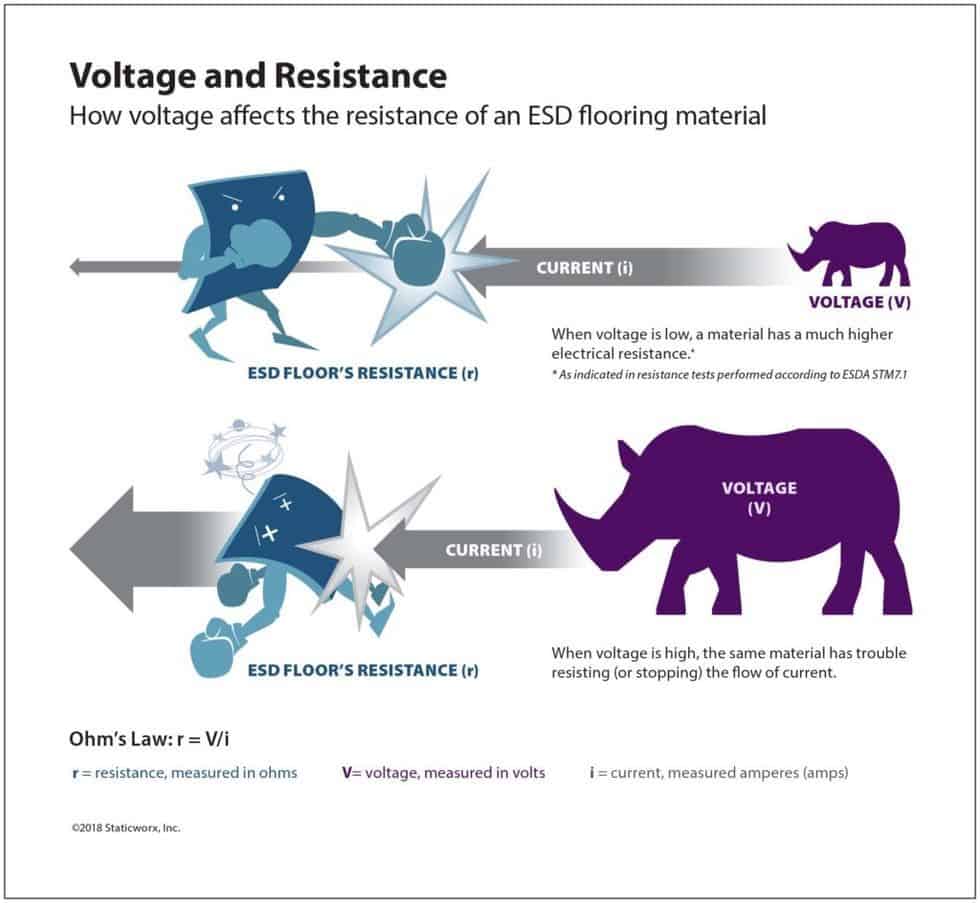
The NFPA considers a resistance of 25,000 ohms (2.5 x 10E4) safe—if the floor is tested at 500 volts. Tested at 10 volts, the same floor would likely measure over 1 x 10E5, or 100,000 ohms. Both resistance measurements are considered safe for applications where energized equipment is in use—based on their test methods.
Now, consider the reverse: more applied voltage yields lower resistance readings.
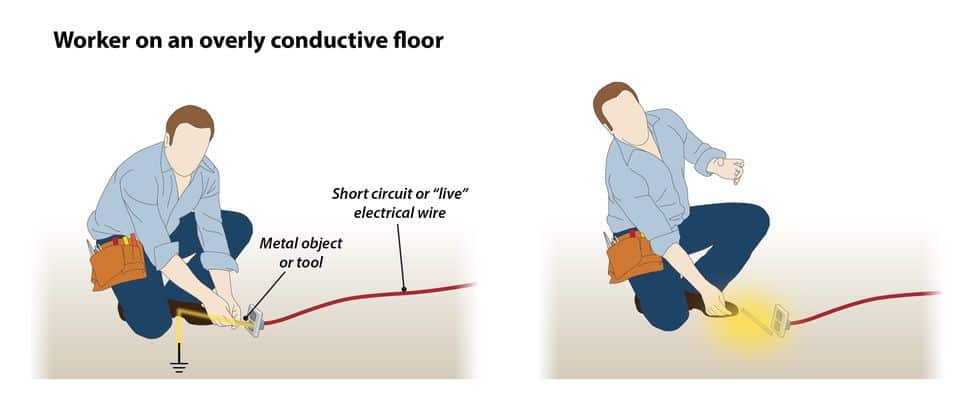
Suppose, at 10 volts, per ESD 7.1, a floor measures 25,000 ohms. At 500 volts, the same floor could measure as low as 2500 ohms—a resistance so dangerously low that electricity would rocket across its surface, at a rate lethal to humans.
If someone standing or kneeling on an overly conductive floor were to accidentally become part of a live electrical circuit—while servicing or inspecting electrified equipment, for example—he or she could receive a dangerous electrical shock.
If a manufacturer claims their highly conductive floor meets the defunct NFPA 99 standard, be sure to ask how the floor was tested and exactly how much voltage was applied.
To be sure your floor falls within a safe resistance range:
- prefer suppliers that don’t sell overly conductive floors;
- request independent lab testing;
- specify products with an inherent resistance buffer that’s at least one order of magnitude higher than the minimum, 25,000 ohms (10E5 rather than 10E4).
Neither NFPA 99 or ANSI/ESD STM7.1 should be used as the sole basis for safety judgments.
Download the free Flooring Selector guide.
Ohm’s Law and Calculated Current
In a recent white paper, Ronald Gibson, a retired ESD program manager from Celestica Corporation, pointed out that measurements from D-C resistance meters should never be used to determine if a grounded floor is safe or unsafe. Gibson provided examples demonstrating that actual (as opposed to calculated) A-C electrical currents can be much higher than one would predict by calculating current using ohm meter readings and inserting them into an Ohm’s Law equation.
In Gibson’s example below, the true A-C current (22 milliamps) is actually nine times greater than the calculated current of 2.4 milliamps.
Note: Calculated current is computed using Ohm’s Law. Current equals voltage divided by resistance. 120 volts divided by 50,000 ohms = .0024 or 2.4 milliamps. In theory this means that a 50,000 ohm material would only deliver 2.4 milliamps when subjected to 120 volts AC power.
| Item | Condition | Voltage | Current | Resistance |
|---|---|---|---|---|
| Conductive Scrim inside Table Covering | Current limited Resistance Meter Reading | 10 | 200 uA | 5.0 x 10E4 |
| Calculated current based on Ohm’s Law | 120 | 2.4 milliamps | 5.0 x 10E4 | |
| Actual AC current | 120 | 22 milliamps | 5.4 x 10E3 | |
| Increase in current | Actual current 9 times higher than predicted |
Based on Gibson’s comments we sought the services of an electrical engineering lab to subject conductive and static-dissipative carpet tiles to this same type of scrutiny. The lab’s findings concurred with the data Gibson provided in his paper on electrical safety. As predicted, static-dissipative flooring allowed far less current than conductive flooring.
In these tests, the amount of current delivered through a conductive carpet tile was measured above 50 milliamps. OSHA cites 16 milliamps as the level of current where a person’s muscles would contract and prevent them from letting go of the electrified object.
The A-C current measured across conductive carpet tile was over three times that amount: 50 milliamps is considered a “fatal current.” Since studies have shown that conductive carpet offers no performance advantage over static dissipative carpet, there is no incentive for its use.
Caveat: Electrical Safety Testing
Testing to prove an electrically safe working environment in a room equipped with conductive flooring is not the same as performing a simple set of resistance tests with a current limiting ohm meter. Definitively stating that an environment is “electrically safe” requires special licensing, extensive research and the testing would need to be performed after the flooring has been installed.
To be conclusive, this level of safety testing would need to capture A-C leakage current measurements under conditions simulating an A-C short circuit, similar to the way electrical high voltage safety shoes are tested.