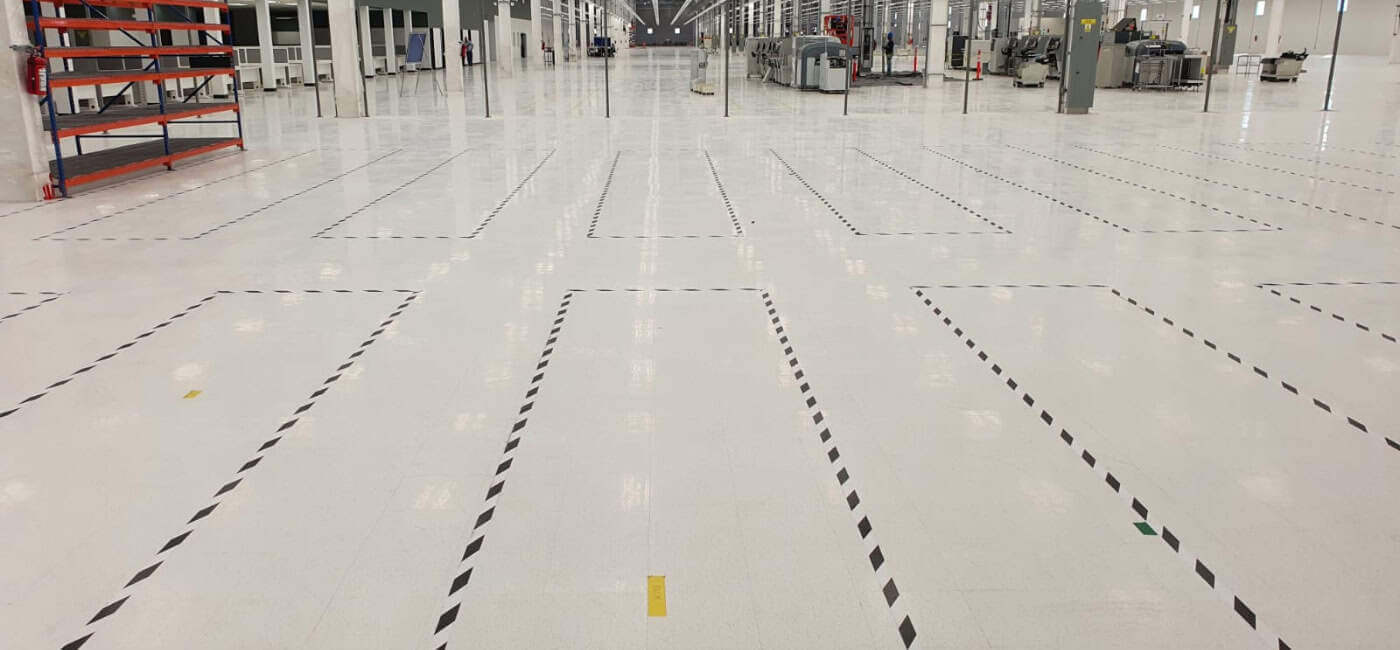
A quick overview of the difference between the two resistance ranges known as static dissipative and static conductive.
Click here to watch our latest video on Conductive versus Dissipative: Does It matter.
Visit our Learning Center to read more about Conductive versus Dissipative: Does It Matter.
For help or advice about choosing an ESD floor, call us on 617-923-2000, email info@staticworx.com, or visit our Guide to ESD Flooring Selection.
Transcript
ESD Flooring: Static Dissipative vs. Static Conductive

ESD Flooring: Static Dissipative vs. Static Conductive
Hi, I’m Dave Long from StaticWorx and today we’re going to talk about my favorite topic: static dissipative versus conductive.
Probably the biggest question we’re asked by any client for the first time when they call is “Which material should I use? Should I use static-dissipative flooring or should I use conductive flooring?” The short answer is neither.
You should be quantifying what you’re buying. You shouldn’t be buying based on a description. Let’s go through it, that way you’ll have the same understanding that I do.
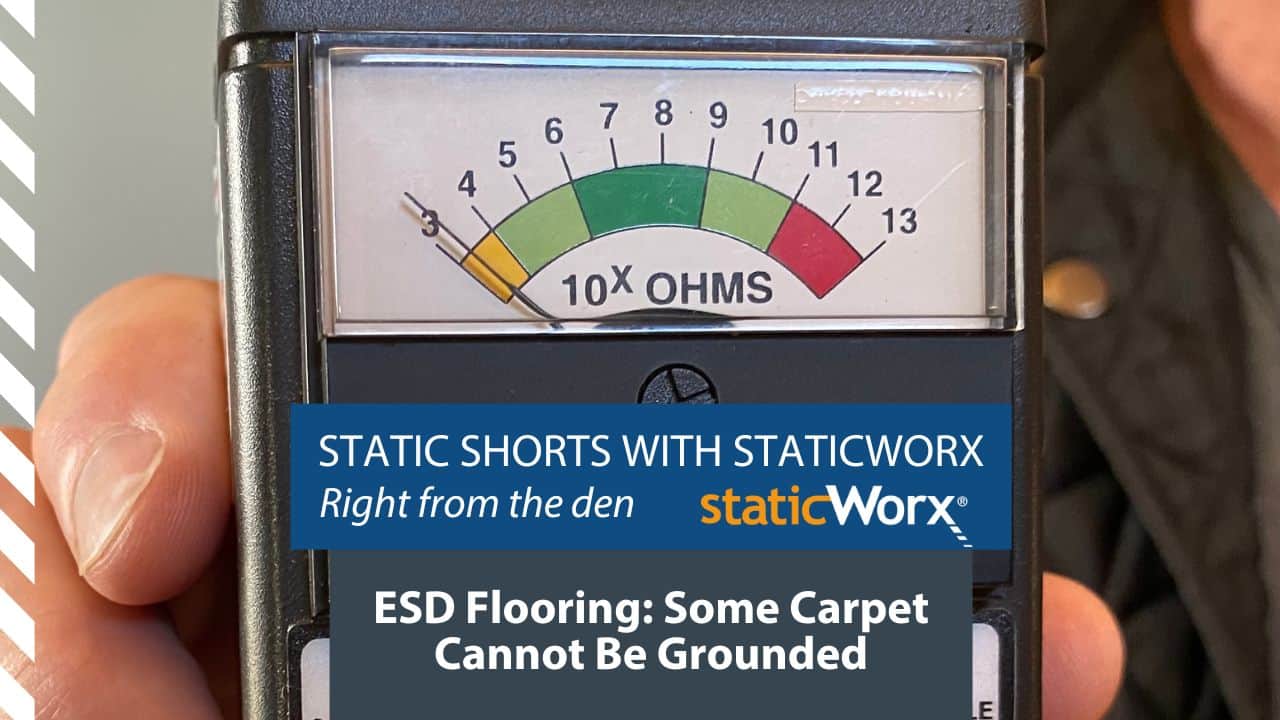
What I’ve done here is I’ve drawn a simple line chart starting at 0 going up to a billion and what I’m going to be plotting here, we call ohms. Ohms is the unit of measurement that we use to determine how conductive a material is. Ohms is a property that allows us to predict how rapidly we can eliminate static going through one of our floors.
So what I’m actually telling you is that if a floor has zero ohms it’s very, very, very conductive. Like a puddle of water, stainless steel, copper. If a floor has a billion ohms, it’s like the carpet in your living room. A billion ohms is so many ohms
that anything over that amount the floor is not going to have the ability to eliminate static at all.
So what we need to do is find the sweet spot. That place where the conductivity is just right, that allows the floor to prevent static, ground static, and keep you safe, so that you’re not grounded so close to the earth that if you touch an electrical circuit you’re going to get a shock.
One of the problems with reading specification sheets, is inconsistencies in how they quantify materials. What you’ll see sometimes on a spec sheet, is an ohms rating of 10E4 to 10E6. People call me all the time and say “what does that mean?” If you go back and look at your mathematics from high school, you’ll remember that 10,000 is the same thing as 10E4 place. Four decimals away from 0. 10E5 is 100,000, 10E6 there’s a million. So when you see these numbers you can either look at them as exponents or you can look at them as as actual values
So let’s take a look at how we can plot this out. Right now, if you look up a definition for static dissipative, that definition will tell you that any material from a million ohms to a billion ohms is called static dissipative. If you look up the definition of conductive flooring, you’ll determine that any floor that has a resistance of a million ohms or less–and by the way they don’t specify the low number–anything from a million ohms or less is static conductive.
Well, right now we’ve got two choices: something that goes all the way down to zero and something that goes all the way up to a point where it’s so not conductive that it won’t get rid of static electricity. So how do we know which material to use? Well fortunately, we have other standards.
One of the standards we have is called ANSI 20.20. This is when you should write down because any time you write a spec, that’s what you want to look at. ANSI 20.20 says that the floor and the person together should have a resistance of less than 35 million ohms. Well 35 million ohms is somewhere in between 10 million and 100 million so let’s call it right here and let’s use the green marker and we’ll say that that’s the highest point of resistance we can have.
The NFPA and OSHA say that the floor has to have always more resistance than 25,000 ohms. Well here’s 10,000, here’s 100, so here’s 25 thousand. So in between here and here, we have the lowest margin where you’re still safe. We have the highest margin where the floor will meet this ANSI 20.20. So we’ve essentially eliminated a big portion of the static-dissipative range. We’ve eliminated a big portion of the conductive range. If you notice, we’re in between the two. We’re saying that some of static dissipative is adequate and some of conductive is adequate.
So that’s why when somebody asks me which material should I get, static dissipative or conductive, my answer is don’t use either term. Specify exactly what the properties of the floor should be and those properties should be more than 25,000 ohms and less than 35 million ohms.
I have one thing to add. Statistically speaking. would you really want something that’s right at the edge of safety? Most people will tell you they don’t want that because what if some other conditions allow the floor to be a little more conductive? Maybe it gets wet. Maybe the installation circumstances are such that it drops the conductivity down because of some pre-existing condition. So what we look at is a little bit of margin of error. We like to use a hundred thousand ohms as our minimum resistance. So when we talk about a floor that’s going to be safe but still work, what we’re talking about is a floor that will measure between 100,000 ohms and 35 million ohms.
What I would suggest is if you want to know more, go to our website go to the Knowledge and Safety Center and read some of the articles on floor testing, read some of the articles on the proper conductivity for grounding. Don’t just end it here. This is just the beginning. And of course you have the ability to pick up the phone any time you want and call me at [617-923-2000].