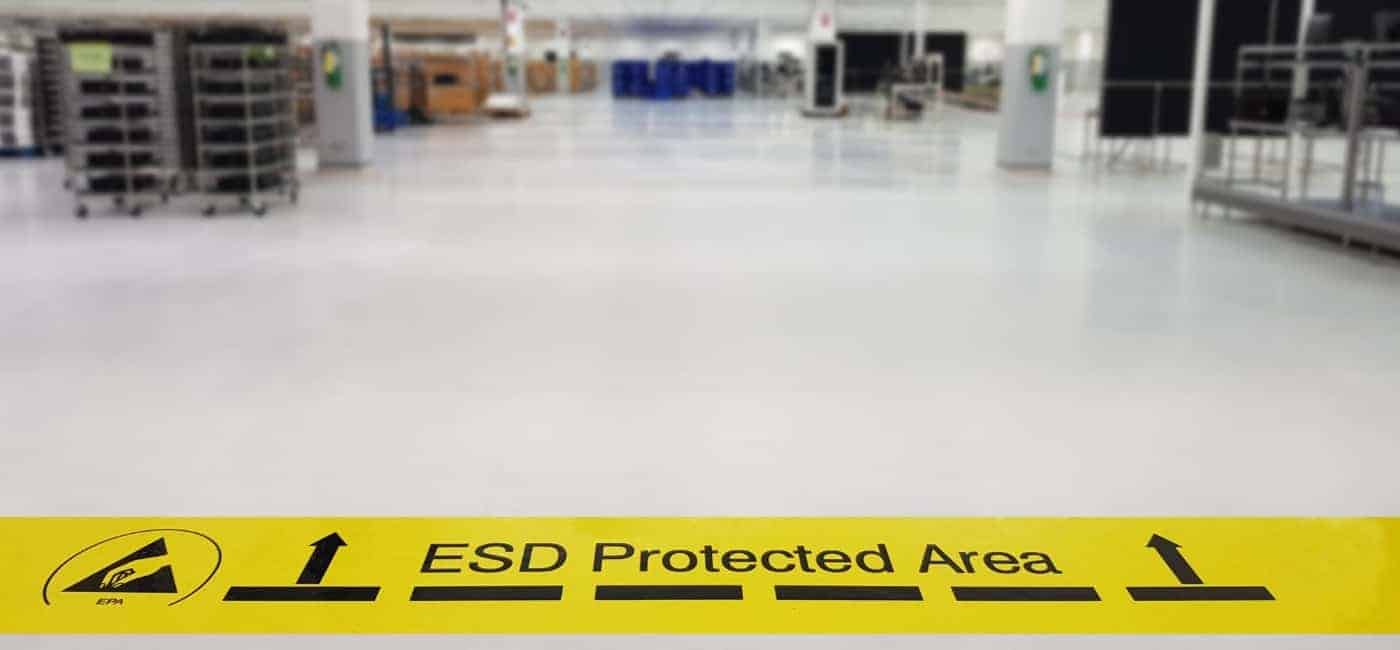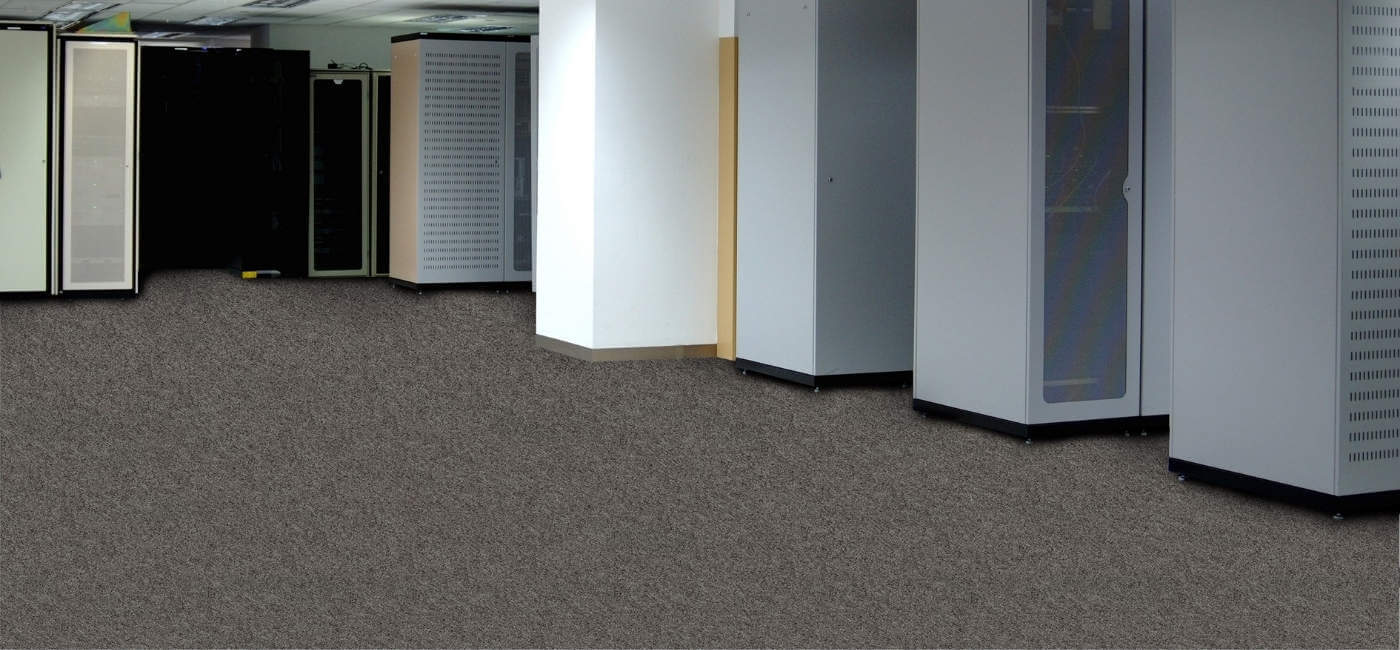
Selecting an antistatic floor for a data center, server room or other mission-critical space involves a number of considerations. The most important is the type of footwear people wear. The soles of some shoes – e.g., athletic shoes with polyurethane or PVC soles – generate static.
The conductive elements in ESD-protective footwear, such as heel straps, form an electrical bond between shoe soles and the conductive particles inherent in high-quality ESD flooring (also known as antistatic flooring or static-control flooring).
Typically, footwear is not controlled in data centers, server rooms and other end-user spaces. In other words, people are not required to wear special ESD-protective footwear. For this reason, the ESD floor must inhibit static regardless of the type of shoes people wear in the workplace.
Approaching the selection process from this perspective enables you to inhibit static generation on anyone, anytime, regardless of humidity, the sensitivity of your servers or the application and critical nature the servers represent to your mission or operation.
The effectiveness of static-control flooring is based on:
- The floor’s ability to prevent static regardless of traffic, humidity or the type of footwear worn by people occupying the space. This property, called preventing body voltage generation or BVG, is measured using test method ANSI/ESD S97.2. Tests should include measurements with and without static control footwear.
- The intrinsic ability of the floor to be grounded or produce a traceable ground path. Electrical conductivity is measured using test method ANSI/ESD S7.1. Test samples should be preconditioned at humidity levels below 20%. In the case of ESD carpet, the test should be performed on new and used carpet to determine if traffic and abuse will degrade the Groundable path.
Read: What is the best antistatic flooring option for data centers and server rooms?
Applications
- 911 Call Centers
- Command Centers
- Control Rooms
- Data Storage Centers
- Computer Rooms
- Secure Compartments
- Research and Development Areas
- Radio and Television
- Hospitals
- Stock Exchanges
- Flight Control Towers
- Laboratories
- Mission Critical NOCs
- Engineering Areas
- Medical Records Areas
Applicable ESD Standards
ESD standards are not universal. Standards vary, determined by industry and application. Applicable standards for data centers, server rooms, and mission-critical spaces include:
Motorola R56
The Motorola guidelines have become the recognized standard in the telecom industry and serve as the most complete and rigorous specification for the protection of communication system equipment installed at public safety and commercial wireless communication sites.
Excerpt from Appendix C 3.3 – 68P81089E50-B: “Carpeting or floor tiles within an equipment room or dispatch center, including raised flooring, should have a resistance to ground measurement of between 1,000,000 and 1,000,000,000 ohms.”
ATIS 0600321 (Alliance for Telecommunications Industry Solutions)
ATIS publishes standards for the information, entertainment, and communications industries.
Excerpt from Section 4.2 Flooring: “Any carpeting or floor tiles should have a resistance to ground between 10E6 and 10E10 ohms when measured using the method of ESD-S7.1.”
IBM Data Center Recommendations
Ensuring the maximum resistance for the flooring system is 2 x 10E10 ohms*, measured between the floor surface and the building (or an applicable ground reference). Flooring material with a lower resistance will further decrease static buildup and discharge.
For safety, the floor covering and flooring system should provide a resistance of no less than 150 kilohms** when measured between any two points on the floor space 1 m (3 ft.) apart.
Please note: Resistance and Body Voltage/Charge Generation tests are done following test methods STM 97.1 (resistance) and STM 97.2 (body voltage), outlined in ANSI/ESD S20.20.
Learn more about ESD Standards and Tests
Best-rated Floors for Data Centers, Server Rooms, and End-user Spaces
Ideal: GroundLock Interlocking or Lay-flat tiles.
Material cost: $$$
Glue-free install 24/7, with no downtime; easy to lift and repurpose; high psi; very easy to roll heavy loads.
Disadvantage: Initial cost
Learn more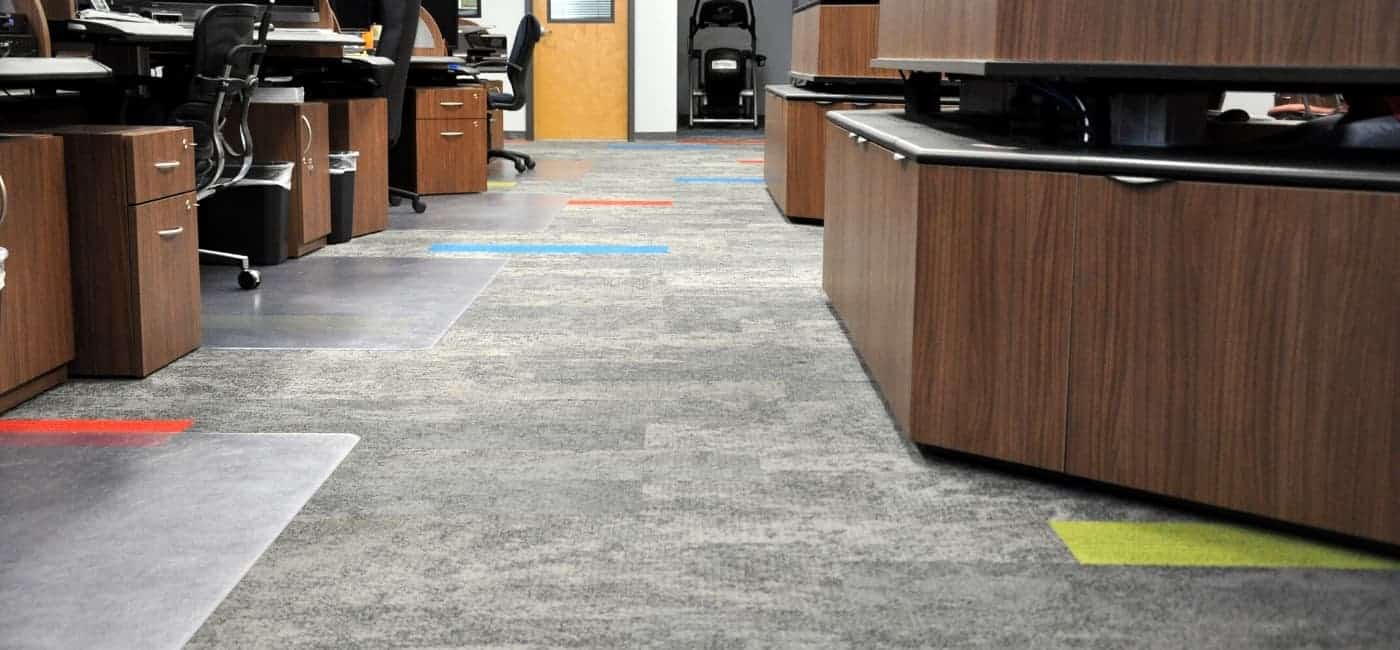
Recommended: ShadowFX Static-dissipative carpet tile
Material cost: $$
Can be installed as a floating floor without adhesive.
Major disadvantage: Soft surface.
Learn more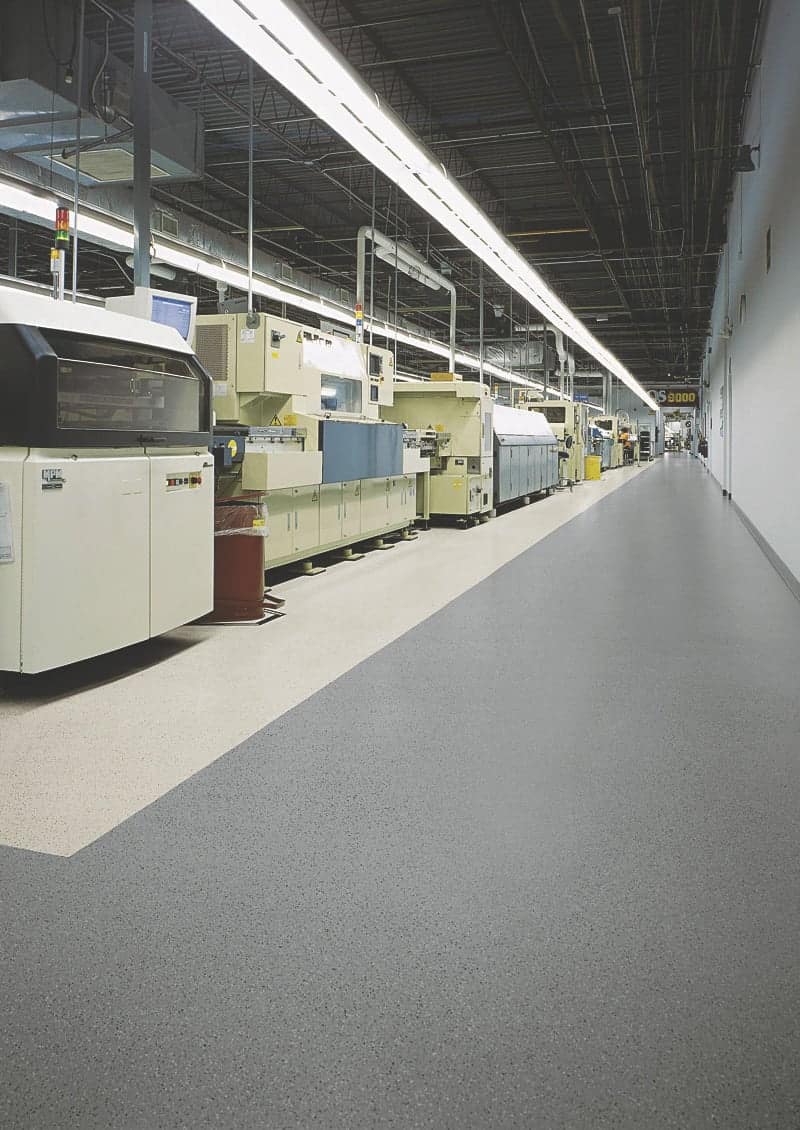
Recommended: 2-layer Eclipse Rubber tile and sheet flooring.
Material cost: $$$
Disadvantage: Initial cost; soft surface.
Learn more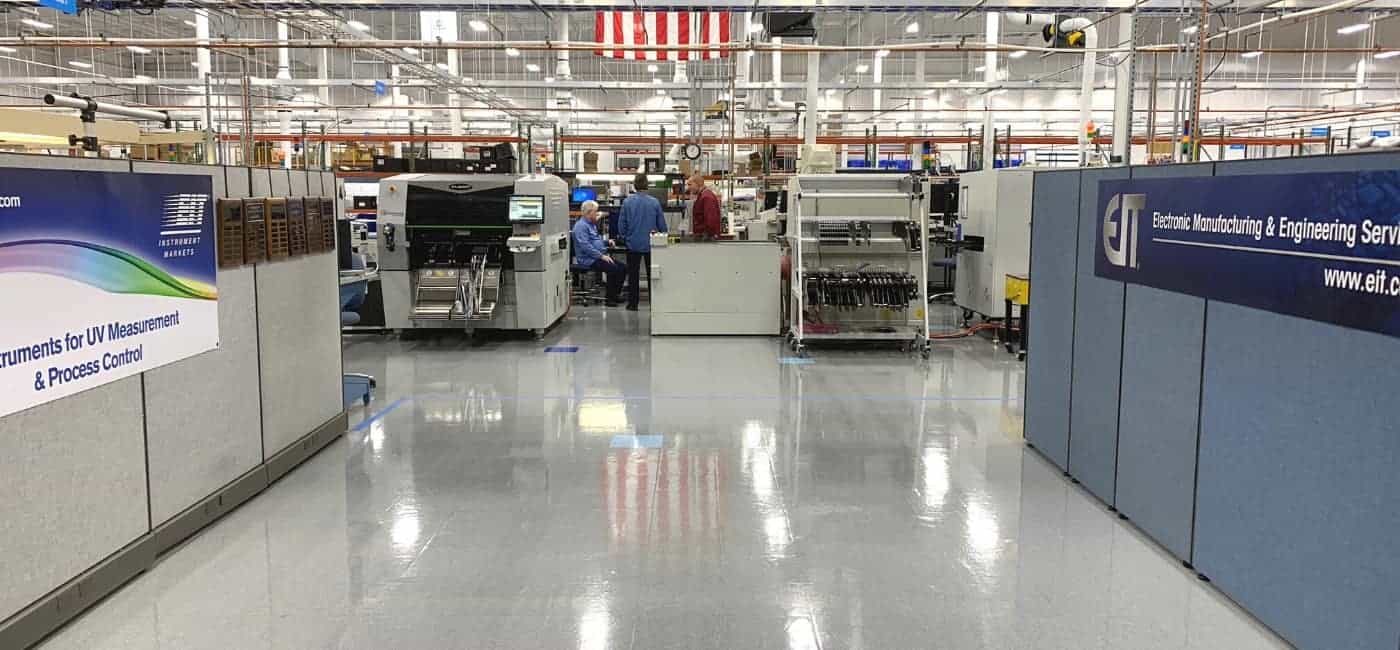
Recommended but less effective than options 1, 2 or 3: Static-control vinyl and generation 3 ESD coatings
Material cost: $$
Disadvantage: Should be used in conjunction with antistatic (ESD-protective) footwear.
Learn moreNot Recommended: High Pressure Laminate
HPL is comprised of six to eight layers of resin-impregnated kraft paper, decorative paper (with a pattern, color or woodgrain) and a decorative overlay. These layers are manufactured under 1000kg per-square-meter of pressure at temperatures of 140°C+ (284°F).
With HPL, the decorative layer does not inhibit body voltage generation. And HPL does a poor job of grounding the ESD casters on static-control seating.
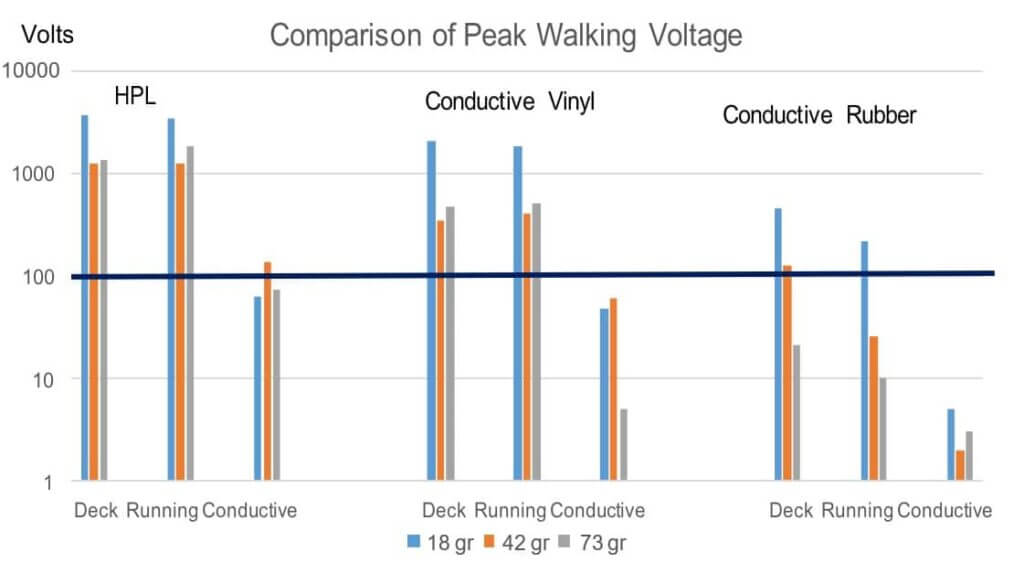
Chart 1. Comparison of three (3) types of footwear on three (3) types of floor at three (3) environmental moisture levels – Peak walking voltage.
- Moisture levels, shown in grains of water per pound of dry air, are equivalent to 15%, 35% and 60% Rh at 23°C
- The ASHRAE group established 500 volts as the maximum on personnel for service operations.
Used by permission: David E. Swenson
ESD Seating
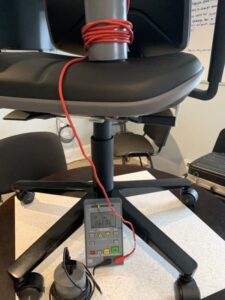
ESD floors dissipate (and inhibit) static charges as we walk. When we sit in a regular (non-ESD) chair, we are no longer grounded – even if the chair itself is sitting on an ESD floor.
The friction we generate by moving – when we shuffle our feet, take off a sweater, set a disposable cup on our desk – creates static electricity. Static on our body stays in place and jumps to whatever we touch. If we’re sitting in a regular (non-ESD) chair and touch electronic equipment, the jolt of electricity can damage or destroy the component’s internal circuitry.
That’s why it’s crucial to complete the static-protective chain.
StaticWorx ESD Bolt™ chairs, made with static-dissipative materials, ground people while they sit – preventing static charges from building on their body – and discharge static to ground.
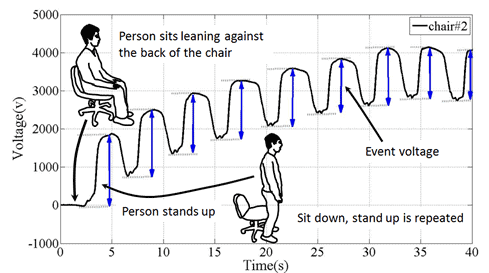
When standing up from a non-ESD chair, voltage rises. After standing up, voltage may drop slowly (figure above) or rapidly (Figure 2) depending on the shoe/floor resistance.
From: Dependence of ESD Charge Voltage on Humidity in a Data Centers, Part 1
Used by permission: David E. Swenson
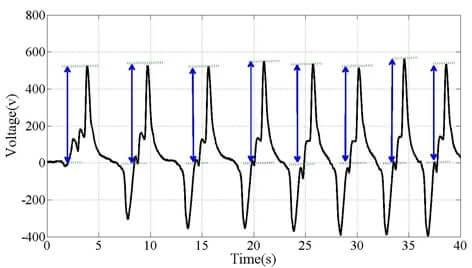
Figure 2 Definition of the chair event voltage for cases in which the shoe/floor system discharges rapidly from the person (shown here: Rubber ESD floor, mid-range dissipative shoes at 38C and 8% RH).
By permission: David E. Swenson
ESD Seating Features
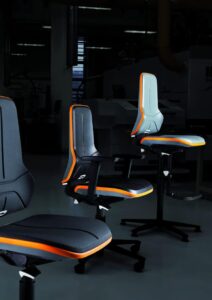
- Elegant lines
- Slim outline
- Efficient star base
- Soft, comfortable upholstery
- Comfort seating
- Optimal support
- Washable
- Easy care
- Hygienic
- Seamless joints
- Resistance under 1.0 x 10E9
- Low static generating
- Meets ANSI/ESD S20.20
Learn about StaticWorx Bolt ESD chairs
CHECKLIST: CHOOSING THE RIGHT STATIC-CONTROL FLOORING
- Only static-dissipative and conductive floors can be grounded.
- Standard flooring installed with ground strips or conductive adhesive will not offer any static protection.
- Industry standards for data centers and server rooms require floors to measure above 150,000 ohms (1.5 x 10E5) and less than 1,000,000,000 (1.0 x 10E9).
- Most StaticWorx flooring options (See Recommended) meet this guideline.
- Any effective static-control floor can be verified with an ohm meter to determine the electrical resistance of the material.
- If the material does not pass the ohm meter test then it cannot be grounded.
- Static-dissipative and conductive floors should never require any antistatic sprays or waxes to enhance or maintain performance.
- The dissipative properties should be achieved by the physical composition of the material – not by a maintenance additive or ongoing dependent process.
- The floor should reduce static electricity regardless of relative humidity.
- Ask the supplier specifically about performance in very dry conditions (See ASHRAE study).
- The floor must inhibit static buildup in real world conditions without special static-free shoes or shoe straps and eliminate static with special footwear.
- When in doubt, ask for independent test data verifying this property. It should be available.
- The data should be derived from installed floors and from low humidity lab tests of new flooring.
- Never assume that a shock-free environment means a static-free environment.
- A shock-free environment only means that static charges are below 3500 volts. ASHRAE has set 500 volts or .5kV as a limit for static buildup when accessing sensitive equipment.
- Do the homework up front.
- It is much more costly to remove an ineffective floor and replace it than it is to do it right the first time.
- Any mission-critical space is only as secure as its Achilles’ heel.
- Prepare for tomorrow. Have a plan.
- Smaller means more sensitive! Transistors in microelectronic devices inside data storage equipment are becoming more dense, smaller, faster and more sensitive. In the past 10 years, the industry has evolved from 14nm nodes to 10nm to 7nm to 5nm to anticipation studies that suggest the potential exists for 3nm and below.
As with any potential security breach, it is always best to plan ahead.
Read
- What is the best antistatic flooring option for data centers and server rooms?
- Choosing ESD Floors for Mission Critical Spaces
- Electrical Resistance in Mission Critical Spaces
Listen
In this episode, Dave discusses ESD floors and electrical safety. At some point when discussing grounded conductive floors, the question of safety always arises, along with whether or not grounding a conductive floor puts people in harm’s way. Referring to an actual case study, Dave talks about a situation in which a floor installed for the FAA was too conductive to meet the FAA safety standards. The client had been told that drying the pressure-sensitive adhesive would solve the problem, making the entire floor less conductive. Dave talks about why this is not true, and why it’s extremely important to adhere to electrical standards as they are written.