

Rick: Welcome to Static Bursts. Our podcast series will discuss the threat static electricity poses to your business and how to address those risks.
Dave: I’m your host, Dave Long, founder and president of StaticWorx. We make static-control flooring.
Rick: And I’m your co-host, Rick Frauton. And in this episode of static bursts we continue our discussion of the key factors to consider when selecting static-control flooring for your business. Previously, we discussed how application and aesthetics as well as installation and maintenance methods can influence your selection. Today we will be covering factors such as ergonomics, sound attenuation, and the total cost of ownership over time.
Dave, what else should buyers of ESD flooring consider when deciding which type of floor is most suitable for their facility?
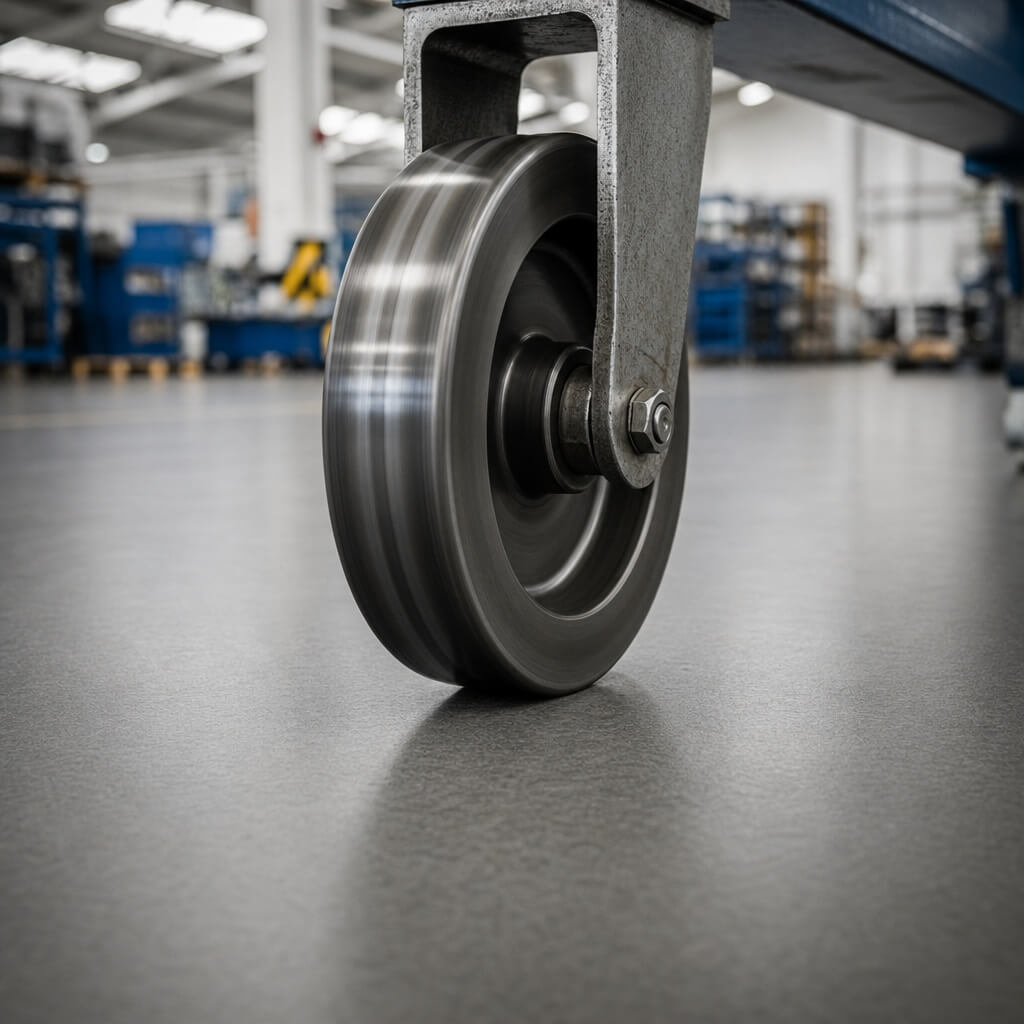
Dave: Rolling loads. Suppose you’re in a data center or you’re in a factory where you’re building systems that are kind of heavy and they’re on four swivel-casters. Well, there are floors that look like they’re hard floors – like some of these invisible, like seamless, interlocking floors – they’re actually kind of soft. If you try to roll a heavy machine on them, the machine actually takes a set in the floor, and it’s a lot harder to move. If you’ve got employees that were accustomed, on bare concrete, to rolling a 3000 pound system without any problem just by pushing it with their hand – and suddenly you’ve given them an ESD floor that has a little bit of softness to it, that could be a problem that has nothing to do with all the other key parameters except that now you can need two people to move the system instead of one.
Another factor noise attenuation. Back to the call center. If it’s a police department say they have 10 dispatchers all involved in conversations in a large municipal area, and one of the important factors in those kinds of conversations is they need to concentrate on who they’re talking to. They need to be completely at ease and ready to help whoever calls. If those 10 conversations all jumble because the floor is a hard surface, and there’s a lot of noise in the room, that’s going to make their job a lot more difficult. So they may want to use a carpet solution, maybe a rubber solution. Carpet tends to attenuate noise, the best. Rubber, it’s okay.
It’s not vinyl, obviously, because vinyl would be a loud floor. It’s not an epoxy floor, which would be the probably the worst case scenario for them.
Anti-fatigue characteristics. If people are doing a job in a factory, where they don’t sit at work benches, but all day long, they’re moving systems and sliding circuit boards into the systems, their feet get tired. You don’t want to put them on an epoxy floor; that’s just going to make their job more difficult. They’re going to feel the pains of walking on a hard surface all day long.
So you may want to consider rubber or carpet where anti fatigue properties are needed.
Reflectivity. This was one that was brought to my attention recently, because in certain operations, there are, I guess you could say sub operations where people need to analyze parts under magnification. If the room is too bright, that could be a problem. If the room is too dark, it could be a problem. So you need to think about what kind of lighting do I have? Do I need new lighting to make it work with my floor?
And then I guess one of the real key factors is cost and time that you plan to be in the same space. And I’m rolling those together because, if you are going to sign a 10-year lease or buy a building, you can invest in that building. You can know that what you’re going to be putting in that building, you’re going to get the most out of it. But what if it’s a two year lease – you might want to think about an interlocking floor. You might want to think about one of these carpet tile solutions, like we offer that has what we call TacTiles that holds corners of carpet tiles together, securely, permanently – but if you decide to move, you can just peel them apart and redeploy them in the new space. Or the interlocking floor that Looks like a bunch of puzzle fingers that are all secured together. But when it’s time to vacate the space and move the floor, you can take it apart and bring it with you.
Rick: Well, that is certainly a lot to consider. And it’s clear why there isn’t one type of flooring that’s suitable for any given industry. One factor we have not discussed, which is surely on our listeners’ minds, is what is the cost of static-control flooring?
Dave: So I’ve left cost to the end. The only reason I have is I think all these other factors have something to do with cost. When people call us, the first thing they always want to know is what does an ESD floor cost? And I always tell them right up front, anywhere from x to z, and I give them some numbers based on the little bit of input that they usually give me when they ask that question. But the real heart of the matter is, if you haven’t thought about these factors that we just talked about, how are you going to analyze cost?
Suppose you buy a floor that’s on liquidation. It’s some company that brings in flooring from a foreign factory, and they’ve got an overage on it, and they decide to sell it to you for $2 a square foot. But the floor needs to be installed with an epoxy adhesive, and you’re going to be putting it in a clean room. You’re going to pay more money for the labor, because of the way it has to be installed and the prep work that has to be done, then that floor is worth. So you need to look at all the factors before you actually say, this is what it costs. I mean, there’s a lot of ways to put this but I guess the best way is total cost of ownership. Am I my willing to pay for something a little bit upfront, so that I don’t have to deal with a lot of other problems?
I’ll give you an example. There are vinyl products on the market, static-dissipative vinyl in particular, that require three to five coats of a special floor polish. If you’re an architect or a designer, and you specify that product, a lot of times you don’t even know about this wax, because it’s in the maintenance instructions. It’s not on the cut sheet about the product itself.
So what you’re actually telling the customer is, you’re going to buy this floor that typically sells for, I don’t know, I’m going to just use an average number that I hear. It’s going to cost $5 a square foot for the material, but then it’s going to turn around and cost you another $2 a square foot in maintenance every year. Well, that might get hidden because you’ve got two different budgets that are being drawn from but it’s same bank account.
So you need to really look at all the other factors before you put a number on cost. Same thing with carpet tile, you could have two different carpet tiles. If one of the carpet tiles is made with yarn that has an extremely low modification ratio – and by that I mean that the fibers are designed geometrically for durability and to prevent trampling, which in turn, diminishes the loss of appearance – if that carpet tile is the same price or even if it’s marginally more money, if it has a low modification ratio, it’s going to last a lot longer than an alternative product.
If you’re in a 9-1-1 call center, and you’re installing carpet tile as your static fix for your floor, your real cost isn’t the carpet tile. It’s figuring out all the strategies that you need to implement in order to put that new floor into that call center without shutting it down. So you might buy carpet tile, and I don’t know what the installer is going to charge you, but I’ll use a high number here. Call it $6 a square foot. If you’re paying $6 a square foot, but it’s going to cost you a tremendous amount of money and time to move consoles and have those consoles recertified by Department of Homeland Security because maybe you’ve disconnected your systems and they need to come in and make sure that you’re secure in your communications, the cost, real cost, might be in all the auxiliary things you need to implement in order to put that floor in.
You need to be looking at the floor and saying, I need to buy a design and a material that’s extremely durable, because I don’t want to do it again. So you might find something that’s half the cost. Maybe it’s once again on liquidation. What good is that going to do you if it’s something you’re going to want to replace in three or four years? So cost is not a number. Cost is an observation of a number of factors.
Rick: We now know that cost is not limited to the price per square foot for the flooring material alone. To understand the full cost of ownership over time, it’s very important to weigh factors such as installation methods and maintenance routines, as well as the cost of any operational downtime associated with these activities.
Dave, do you have any final thoughts for anyone who is responsible for selecting an ESD? floor?
Dave: So my advice in most cases, especially when I’m invited to decision meeting, is to put a matrix together and weigh all these factors. Give them a score from one to five, and maybe even factor in how they would influence your thoughts about cost. What are the shutdown costs? Are there actually productivity costs that I’m not taking into consideration? And do the math.
Put the numbers down, based on installation strategies, maintenance, rolling loads, ergonomics, whether it addresses your application or not. And I think if you do this objectively, and you do it fairly, and you include the right people in your organization, which includes people who work in the space, people are going to pay for the floor, people who are going to take care of the floor, I think what you’ll discover is you’ll end up with, if not one choice, an intelligent opportunity to choose between one choice and another. Because keep in mind, you’ve got carpet, you’ve got epoxy, you’ve got vinyl, you’ve got rubber, you’ve got sheet versions, rolls, of some of these floors. You’ve got waxes, you’ve got paints, the options are there. It’s a matter of intelligently and objectively choosing them and not having a closed mind to them. So the takeaway of this podcast is that you have to look at all the factors. If you don’t look at all the factors, you’ve got blinders on.
We hope you learned something today. If you have questions about the podcast, give us a call at 617-923-2000. Even though we specialize in solving problems with flooring, if you have a question about static discharge, how to install a floor, how to test the floor, we’ll be glad to help you. Thanks for listening.