

Rick: Welcome to Static Bursts. The info-packed three-minute podcast from Staticworx designed for a quick listen.
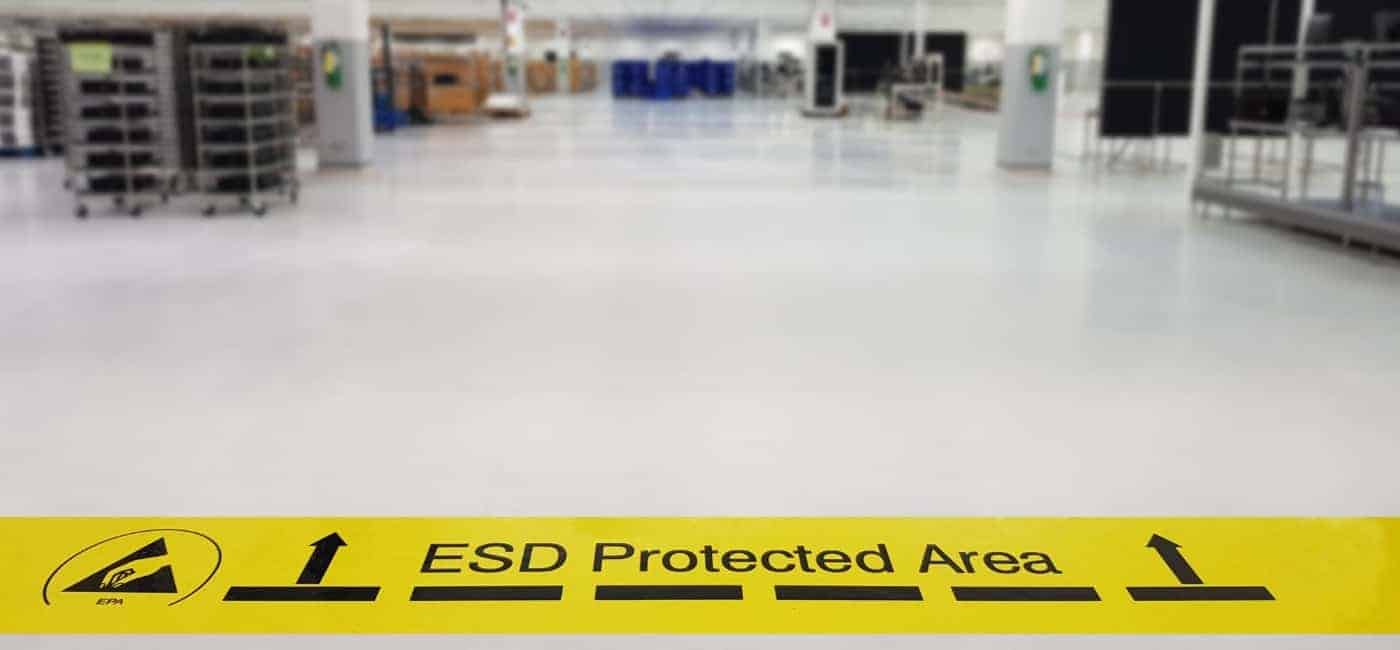
Dave, could you explain to our listeners why there is no one type of ESD flooring that is suitable for all applications.
Dave: Certain types of static control floors work extremely well in one application and don’t do anything in another application. For example, we manufacture conductive and static-dissipative vinyl. Conductive and static-dissipative vinyl is made and actually promoted to be used in conjunction with static-control footwear. Regular footwear doesn’t allow static electricity to escape your body and dissipate to a floor. You need static control-footwear to do that.
Rick: Without getting into too much technical detail, could you briefly describe how ESD flooring takes an electrical charge from someone’s body through to ground.
Dave: Those floors are made with carbon particles that require special footwear that allows the charge to leave your body through the skin and your feet through the sweat layer of your stockings, and it has to be dissipated to the floor through either an ESD foot strap or special ESD shoes.
Rick: Could you provide some examples of applications for ESD floors that effectively manage static electricity without the use of specialized ESD footwear?
Dave: Data centers, flight towers, server rooms, critical call centers like 911 call centers, Homeland Security emergency operations. In these types of environments, you’re not going to have the flexibility to change the type of footwear that people have on their feet from when they left their home in the morning. Those floors need to inhibit the generation of static electricity in the first place. And typically, in those applications, the only floors that they should be using are either static-control carpet or static-control rubber. And the reason for that is both of those types of floors naturally inhibit static, regardless of the type of footwear that you wear.
Rick: So clearly, there is no silver bullet solution for preventing static buildup in all situations. What advice would you offer to someone who’s in the market for an ESD floor but who may not know which type of ESD flooring is most suitable for their particular application?
Dave: If you are hearing that the same material will work for every application, even if you don’t know why it won’t but you’re hearing that it will work for every application – that’s probably not someone you want to deal with.
I hope you learned something today. If you have questions about the podcast, give us a call at 617-923-2000. Thanks for listening.