When selecting electrostatic discharge (ESD) flooring for a facility that manufactures, handles or uses electronic equipment, there are two main options: conductive and static dissipative. Both are ESD floors, designed to prevent electrostatic discharge events that could potentially damage or destroy sensitive electronic devices or ignite explosives.
ESD flooring works by drawing static away from people and moving objects and discharging charges to ground. ESD floors are also antistatic, which means they prevent static charge generation; to be antistatic/prevent charge generation, some flooring materials, particularly ESD vinyl and epoxy, require the use of static-protective footwear.
Conductive and dissipative are both ESD floors, both draw charges away from people and moving objects and both discharge static to ground. So, how are they different?
Conductive and Static-dissipative: What’s the Difference?
People sometimes use the terms “conductive” and “static-dissipative” interchangeably. While conductive and dissipative floors are the same in that they both transport electricity or electrical charges, their electrical performance differs. Conductive and dissipative ESD floors differ in how quickly (conductive) or gradually (dissipative) the floor transports electrical charges through the thickness of the material to ground.
Conductive and static dissipative are categories of the broader term “ESD flooring.” The category a floor belongs in is determined only by its electrical resistance, measured with an ohm meter, following guidelines outlined in ANSI/ESD STM7.1.
Conductive floors measure < 1.0 x 10E6
While ANSI/ESD 20.20 provides no lower limit for electrical resistance, most electronics manufacturing and handling facilities only use floors measuring at or above 2.5 x 10E4.
Static-dissipative floors measure ≥ 1.0 x 10E6 and < 1.0 x 10E9.
Conductive or Dissipative: Which is Right for You?
When choosing an ESD floor, there are many factors to consider.
1. Industry and Application
Before choosing an ESD floor it’s important to consider the industry and type of work being done in the facility.
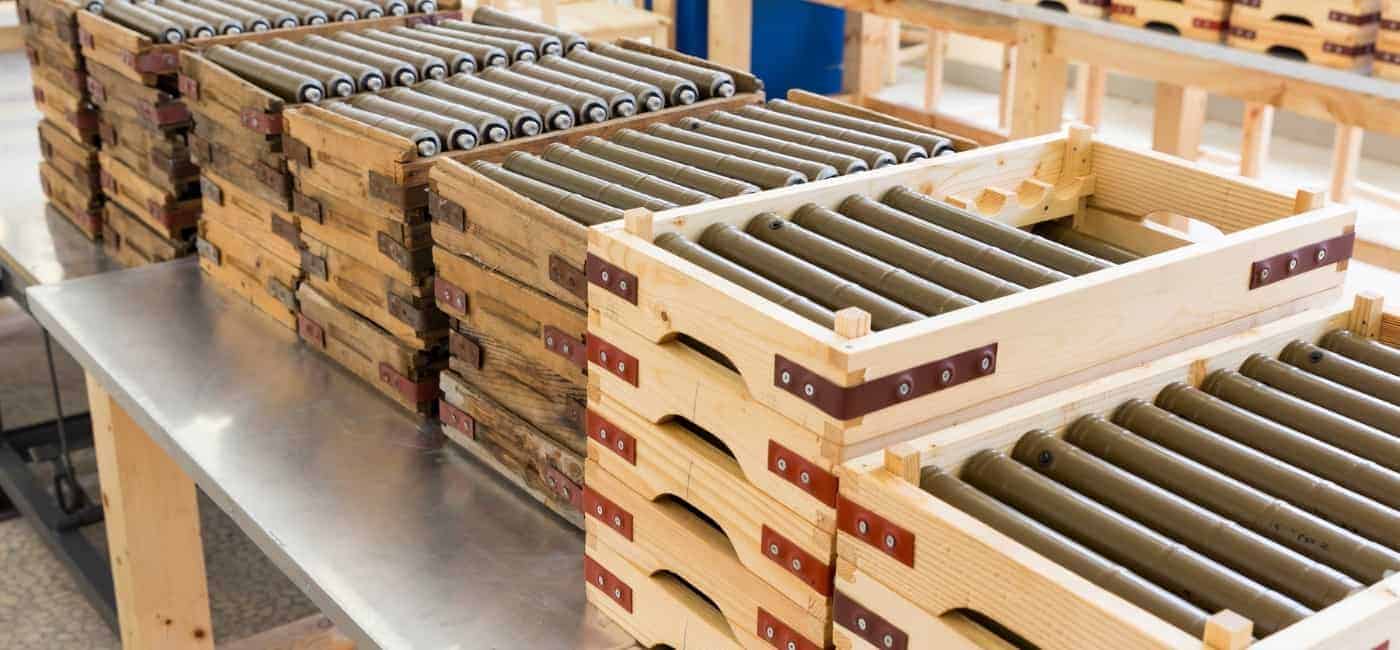
Facilities that manufacture munitions or explosives run the risk of fire or explosion as a static spark can ignite explosive materials. For personnel safety, these facilities prefer conductive, even highly conductive, flooring because they need a floor that quickly transports charges to ground.
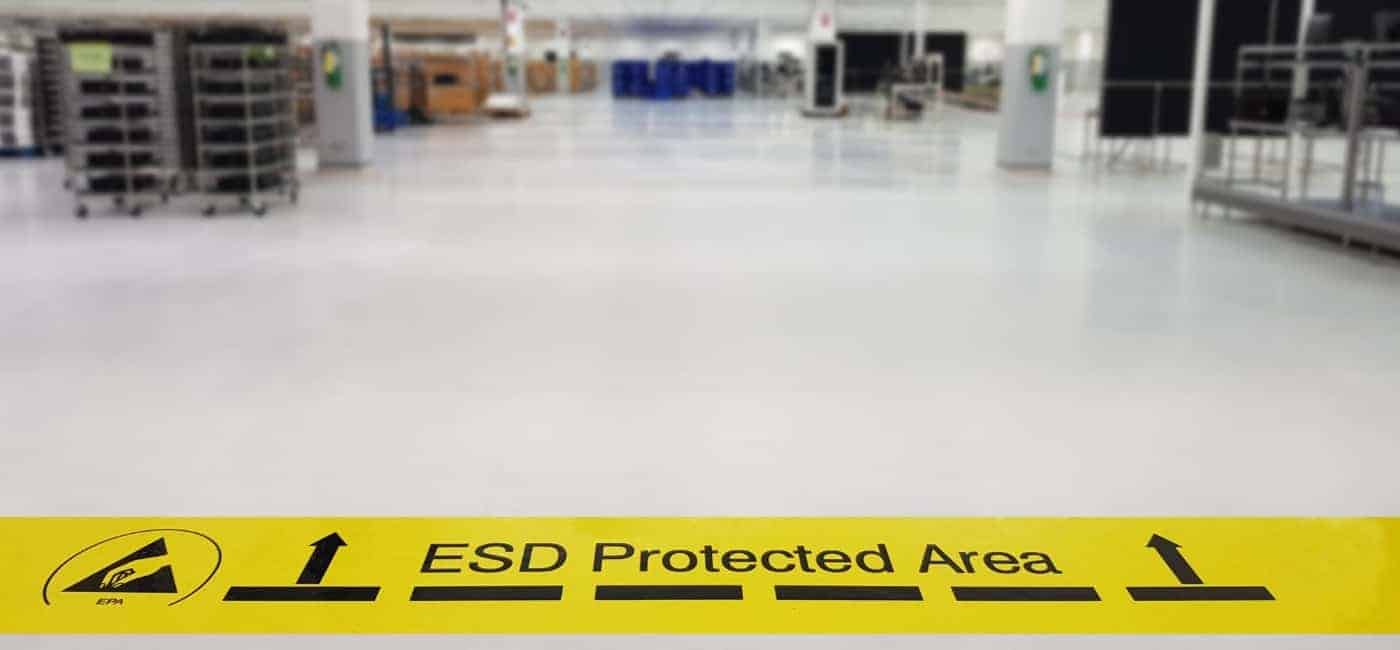
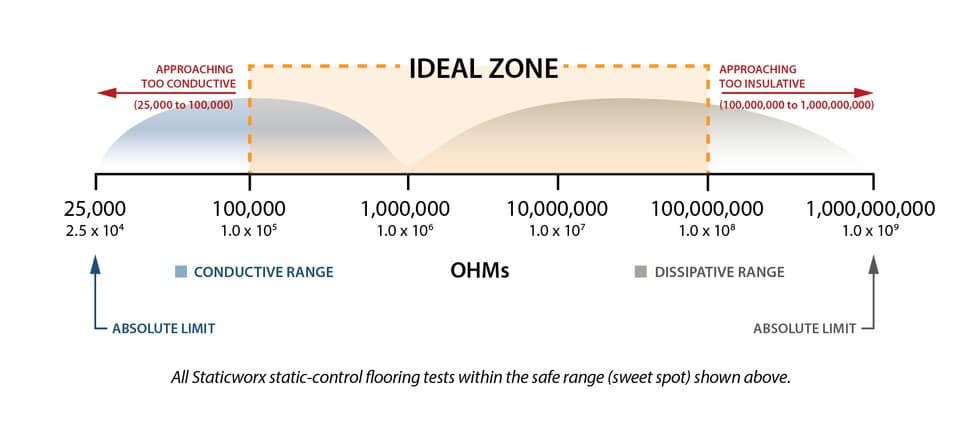
Electronics manufacturing and handling facilities, cleanrooms, TRACON, labs and similar spaces generally prefer floors measuring within what we call “the Sweet Spot” – i.e., between 1.0 x 10E5 and 1.0 x 10E8 – i.e., a floor that is neither too fast nor too slow at transporting electrical charges. Some facilities managers prefer more conductive floors, but the majority do not choose floors measuring below 2.5 x 10E4, for safety reasons.
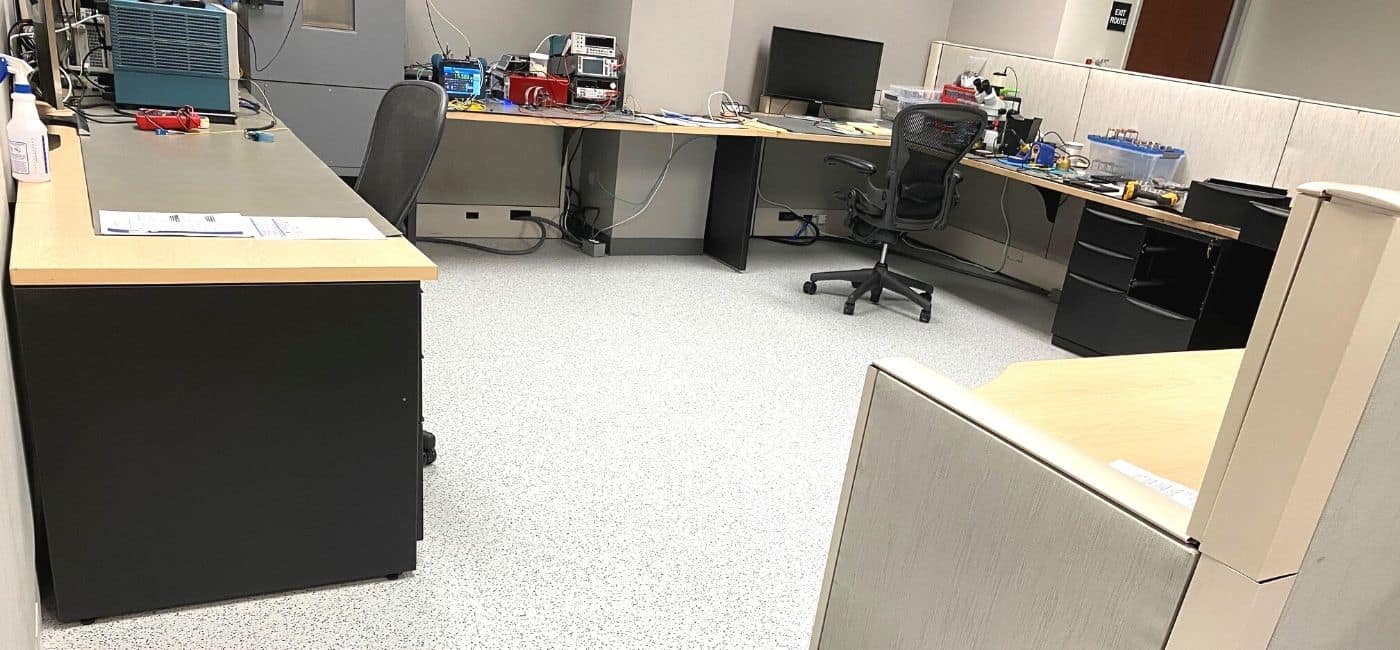
Industry standards require PSAPs, telecommunications, banks, government offices, data centers, media rooms, and similar end-user spaces to use dissipative flooring, measuring > 1.0 x 10E6 and < 1.0 x 10E9.
People working in end-user facilities are typically in routine contact with wired electrical equipment. Static-dissipative flooring transports electrical charges more slowly both to ground and across the surface of the floor. If an electrical component shorted, the floor would inadvertently become part of an electrical circuit. Electricity flows at a more controlled rate across a static-dissipative floor. Independent lab tests have shown that the risk of electrical shock is lower with static-dissipative than conductive flooring, making it a safer choice for personnel working in these types of facilities.
2. Electrical Standards
Resistance standards vary across industries and applications. Always choose flooring that meets standards for your industry.
ANSI/ESD S20.20, for electronics manufacturing and handling facilities, requires ESD flooring to measure < 1.0 x 10E9.
Motorola R56, for public safety and telecom, requires ESD flooring to measure > 1.0 x 10E6 and < 1.0 x 10E10.
ATIS 0600321, for network operator dispatch call centers, requires ESD flooring to measure > 1.0 x 10E6 and < 1.0 x 10E10.
StaticWorx recommends keeping resistance ≤ 1.0 x 10E8. Factors such as ambient conditions or buildup of dirt and dust can affect electrical resistance. At 1.0 x 10E9, if, say, an accumulation of dirt on the floor inhibited contact between shoe soles and conductive elements in the floor, raising resistance, the floor could read in the insulative range.
FAA 019f, for the US Flight towers and facilities that use FAA equipment, requires resistance to read > 1.0 x 10E6 and < 1.0 x 10E9.
Learn more about electrical standards and test methods.
3. Footwear
Whether or not people in your facility wear special ESD-protective footwear has little bearing on whether to choose conductive or dissipative flooring. It does, however, pertain to the flooring material you choose.
ESD flooring has two important functions: the first is to dissipate static to ground. The terms conductive and dissipative refer specifically to the speed at which the floor transports electricity to ground. That’s why resistance is important. The second is to inhibit static generation. That is, for the floor to be antistatic.
Conductive is not the same as antistatic. A floor can be highly conductive – i.e., transport charges very quickly to ground – and still generate a significant amount of static. Flooring materials, such as ESD epoxy and some vinyl floors, are made with a base of resins and polymers that actually generate static.
For a floor that is not antistatic to do its job and protect electronics from random ESD events, all people walking on the floor must wear special ESD-protective footwear. These floors do not perform properly if people do not wear special ESD footwear and the mandate must be strictly enforced. ESD footwear is available as heel straps, toe straps, sole straps and ESD shoes.
Conductive and Static-dissipative carpet, on the other hand, is naturally antistatic. The yarn strands in ESD carpet act as tiny brushes, brushing static off your shoes as you walk. Conductive rubber is the only resilient ESD flooring that is inherently antistatic and does not require ESD footwear.
If you work in or are specifying ESD flooring for a facility, always be sure to ask if people will be wearing ESD footwear. If not, choose a floor that is inherently antistatic and does not require people to wear ESD footwear.
Choosing the right flooring for a facility that manufactures, handles or uses electronic equipment is crucial in preventing random ESD events from damaging electronics or disrupting operations. By considering three important factors—the application, industry standards, and type of footwear in use—facility managers can choose the ESD flooring that best suits their needs, while ensuring the safety and efficiency of their operations.
Read
Static Dissipative Flooring – What It Is & Why You Need It