Static Shorts with StaticWorx: Right from the Den
When thinking about conductive flooring, everyone focuses on the floor material. Everyone focuses on conductivity. One of the things that everyone seems to forget is what’s holding the floor in place? And how long will that product last? In fact, everything about that floor that means anything has to do with the bond and how well it’s secured to the substrate. In this video, Dave Long, President and Founder of StaticWorx, discusses four conductive adhesives. From a conductivity perspective, all four of these adhesives would do exactly what we need it to do in an ESD flooring installation but, as Dave explains, there’s a lot more to consider.
So I guess for starters, from a conductivity perspective, all four of these adhesives would do exactly what we need it to do in an ESD flooring installation. So what I’m going to do is I’m going to pick these apart, because I want you to think about adhesive as the most important part of your project instead of what you’re usually thinking about, which is the floor.
Transcript
How to Choose the Right Conductive Adhesive for ESD Flooring Installations

How to Choose the Right Conductive Adhesive for ESD Flooring Installations
Hi, I’m Dave Long from StaticWorx. Today is April 20th and I decided it was time to talk about a topic that for some reason always gets ignored, and that is conductive adhesives.
Everyone focuses on the floor tile. Everyone focuses on conductivity, which is what this meter measures, but one of the things that everyone seems to forget is what’s holding the floor in place? And how long will that product last? Because if you think about a floor, everything about that floor that means anything has to do with the bond and how well it’s secured to the substrate.
So what I did this morning is I took four adhesive technologies and these are conductive adhesives. So I took an acrylic adhesive. I took a black carbon-loaded releasable adhesive, I took a fiber-loaded releasable adhesive, and I took our brand new StatBond permanent pressure-sensitive adhesive. And the reason I put all four of these together, and excuse the mess, but I’m in my living room and I had to be very careful not to destroy my own house while I was doing this, the first thing I wanted to do is show you that all of these adhesives are conductive. So what I did when I spread them is I overspread them on one another, so this conductive adhesive is touching this one, is touching this one, is touching this one. I put copper at both ends, I put two probes down and I measured the conductivity. And if you look, the electrical continuity from here to here, the resistance is 1.6 times 10 to the fourth (10E4). That means that every member of the chain has to be conductive, otherwise I wouldn’t get a measurement like that.
So I guess for starters, from a conductivity perspective, all four of these adhesives would do exactly what we need it to do in an ESD flooring installation. So what I’m going to do is I’m going to pick these apart, because I want you to think about adhesive as the most important part of your project instead of what you’re usually thinking about, which is the floor.
So here we have the wet-set conductive acrylic adhesive. When I say wet-set, that means that when you trowel it on the floor, before it dries you put tiles on it and then you roll those tiles. When you roll the tiles – and bear in mind, because these are conductive floors, a lot of times the tile color is very light – this adhesive is going to ooze up between the seams once in a while. It’s going to get on the roller. In order to get this mess off of this tile, you’re going to have to use mineral spirits and it’s going to affect the gloss on this tile. So if you’re not careful with wet-set adhesives, you’ve got a mess on your hands. If you are careful with wet-set adhesives, they take much longer to work with than these other three adhesives. So when you’re thinking about a project, one of the things you want to think about, especially if you’re an installer, is how is the adhesive going to affect the performance of my crew? And how much am I going to have to charge the customer to add to the extra annoyances of working with a particular type of product? Because I’m going to tell you right now, if you’re putting flooring in a grocery store, or a retail chain, or a hotel, you’d be using dry adhesives, not wet-set adhesives.
So that brings me to the next adhesive. This one’s been around for a long time. If you notice, it’s got carbon in it, it’s very dark. The problem with this adhesive is that when you work with it, if you touch it, it gets on your fingers, it gets on the tiles. If you step in it, you’ve got footprints all over the place. This particular adhesive is a common one used for installing ESD carpet tiles, sometimes ESD Vinyl tiles, but that’s the mess you’re going to be dealing with. In order to get that off, you’ve got to use mineral spirits.
Third adhesive. This is a releasable pressure-sensitive adhesive with fibers in it. By the way, the reason I did a sloppy job at putting this on the substrate was I wanted you to see these little globs. This has a lot of conductive fiber in it and as a result, the fiber gets into the notches in your trowel, I mean, look how small these notches are. This is the trowel you would use to put down this adhesive. That means as you’re putting tiles down, you’ve got to pay attention to these globs, you’ve got to clean them up and throw them away. So this adhesive has been commonly used for holding conductive vinyl tile for many years. The downside to it, it’s releasable. That means that it doesn’t have the shear strength that you’d really like from a super strong adhesive like the first one. So to give you some idea, this adhesive has a shear strength of over 30 pounds. This adhesive, at its best, has a shear strength of 13 pounds.
That brings me to our new adhesive. So this is a conductive pressure-sensitive permanent adhesive. That means that when I put tiles into it, I’m not going to get ’em off the floor without damaging the substrate just like I would with the first adhesive. The big advantage, when I apply this adhesive, I apply it and I let it dry. That means I don’t get a mess like this. If I get any adhesive on the tile, like I did here, because I purposely smeared it on here, I get that off with soap and water. So here we’re using mineral spirits, which dull the tile, to clean it. Here we’re using soap and water, which is what you’re going to use to clean the floor to begin with.
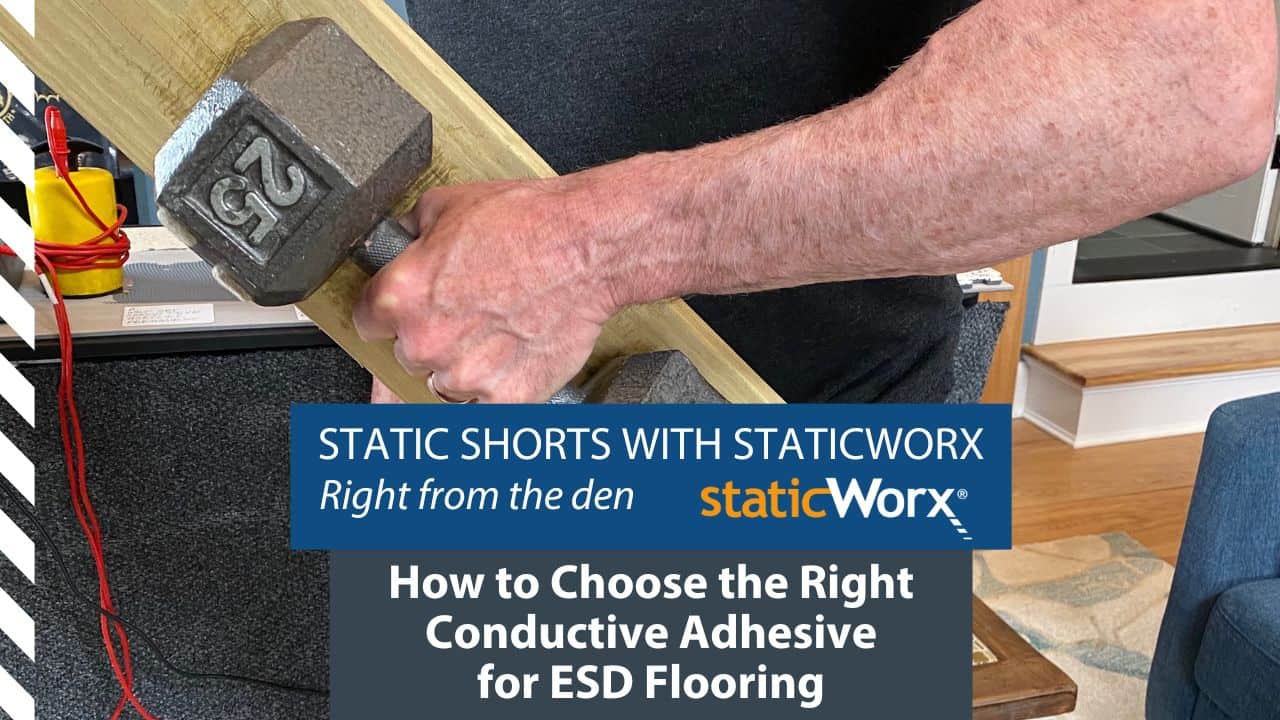
So now what I’m going to do is I’m going to show you the strength of this adhesive. Like I said, for years we and other companies used this adhesive, and the problem with it is it takes five days for it to set up and give you a strong bond. Yesterday, I applied this adhesive to this piece of pressure-treated lumber and I attached a 25-pound dumbbell. So what I’m going to do is I’m going to come over in front of my little podium here and I’m going to take the 25-pound dumbbell and I’m going to hold it upside down. See the bond? That’s what you’re looking for. When you apply a tile to the floor, what you’re looking to have happen is for that tile to grab, be secure, not move, and allow your customer to move in right away.
So back to these other adhesives, you’re not going to want your customer to move in for probably five days if you use a wet-set adhesive. If you use this adhesive, the new StatBond, they can move in as you lay tile. In fact, it will work better, because it’s pressure-sensitive, which means you apply weight and pressure to it and the tiles are stuck.
So that’s it for today. What I’d really like to see is for a little bit of dialog from some of you. If you have questions, we can dig into this a little bit deeper, but I think the overview does a pretty good job of explaining things. Thank you.