Here at StaticWorx, we’ve been getting calls and emails from architects and designers who need to know – quickly – what options they have for static-control flooring for their crucial projects. There’s a lot of rush buying going on right now to equip facilities to make special medical-grade electronic parts. But quick to install isn’t the same as best to install. When you’re choosing flooring, just remember: Conductivity means something. Static generation tests and discharge tests mean something. The term low kV means nothing.
The problem with LVT is it’s being marketed as a low kV floor. When I say low kV, I mean less than 2000 volts of static generation. However, what I’m going to do right now is I’m going to show you why – whether it’s marketed as a low KV floor or not – you shouldn’t even be considering using it.
Transcript
ESD Flooring: Is LVT Antistatic?

ESD Flooring: Is LVT Antistatic?
Hi, I’m Dave Long from StaticWorx, coming to you from my den. Today is April 22nd and the purpose of today’s video is I’ve been getting a lot of calls from designers and architects asking me some unusual questions that I’m not accustomed to hearing. One of the questions I’m being asked constantly is Is LVT an anti-static material? One of the reasons I’m being asked this question is there’s a lot of rush buying going on right now to equip facilities to make special medical-grade electronic parts. In order to accommodate that, companies are actually setting up fast-paced changeovers in their manufacturing process.
So one of the floor materials that’s very easy to install fast over concrete or over a raised floor is LVT. All they need to do is spray an adhesive on the surface, lay these tiles down, and the floor is in place. The problem with LVT is it’s being marketed as a low kV floor. When I say low kV, I mean less than 2000 volts of static generation. However, what I’m going to do right now is I’m going to show you why – whether it’s marketed as a low KV floor or not – you shouldn’t even be considering using it.
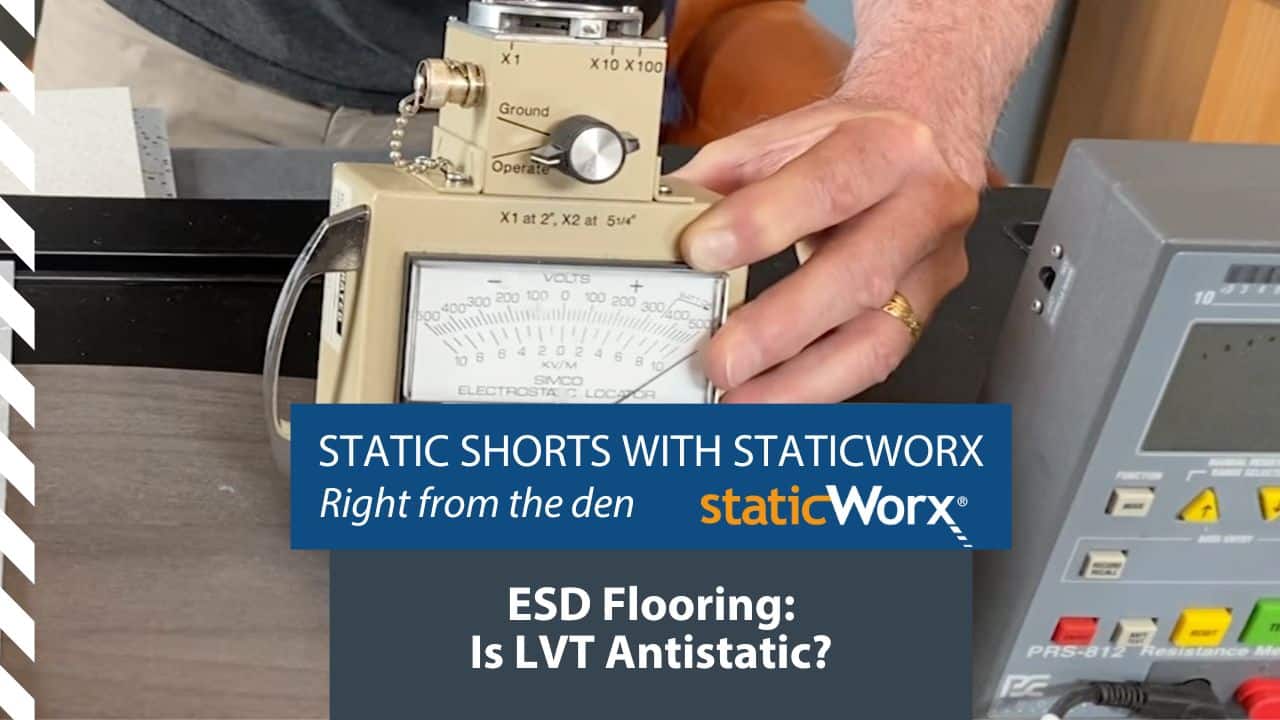
So what I have is a static field meter. If the needle’s in the middle, there’s no charge. If the needle moves to the right, there’s a positive charge, if it moves to the left, there’s a negative charge. I’m going to take this metal plate, which is insulated from my hand with this plastic handle. I’m going to measure the static on it. I’m going to take the metal plate and I’m going to touch it to a copper ground. And if you look closely, here’s the copper, there’s the wire, goes all the way to electrical ground. So I know that copper is grounded. And I touched the plate to the copper and I get rid of the static electricity. So we know this plate can be grounded. And I charge it up, measure it again.
This piece of material that you see, this gray piece of material, the long piece, that’s LVT. I’m going to take the plate and I’m going to touch it to the LVT. You can see there’s copper underneath it. Charge doesn’t go anywhere. That means that this piece of LVT, whether when it’s been sold to someone, it’s rated at 1kV, 2kV, 5kV, it does not eliminate or dissipate static electricity. I’m going to discharge the plate, get it to zero, I’m going to show you one other problem with this LVT. It creates charges on, and this is a conductive object, it creates charges on objects. So if anyone is telling you that you should be thinking about LVT because it’s in stock or can ship quickly, it’s a static generator.
Right next to the LVT, I’ve got an ESD conductive vinyl tile. I do the same thing with the vinyl tile, charge is gone. If I rub the tile, I can’t generate a charge. This gets rid of static electricity, this creates static electricity. One last very simple test I did, I put two probes on the LVT and I measured the electrical resistance. Right now the meter is calibrating, soon as it says good, I’m going to test it and the material is measuring 10 to the 11th (10E11). That’s an exponent. So this is a logarithmic measurement. Anything above nine is considered to be a static generator.
So when you’re talking to suppliers, make sure they know what they’re talking about. I’m not saying that people are intentionally deceiving other people, but there’s a common misconception that low kV actually means something. Conductivity means something. Static generation tests and discharge tests mean something. The term low KV means nothing. Hope I’ve helped you, call me if you have any questions.