Conductive vinyl generates 10 X as much static as conductive rubber on people wearing regular (non-ESD) footwear. So if yours is an end-user space and there’s any chance that people won’t be wearing special footwear, choose a low-static-generating rubber floor.

Rubber conductive flooring does not generate as much body voltage as vinyl. In fact, it’s a factor of over 10.

Transcript

SDT or Rubber: Which is Better?

Toggle transcript

Hi, I’m Dave Long from StaticWorx. What I’m going to show you right now is going to answer, I think, a question that a lot of people have in the backs of their minds. And that is what happens with a conductive floor, when I don’t wear heel straps, because in labs, tech spaces, end-user spaces like server rooms, people don’t wear these.

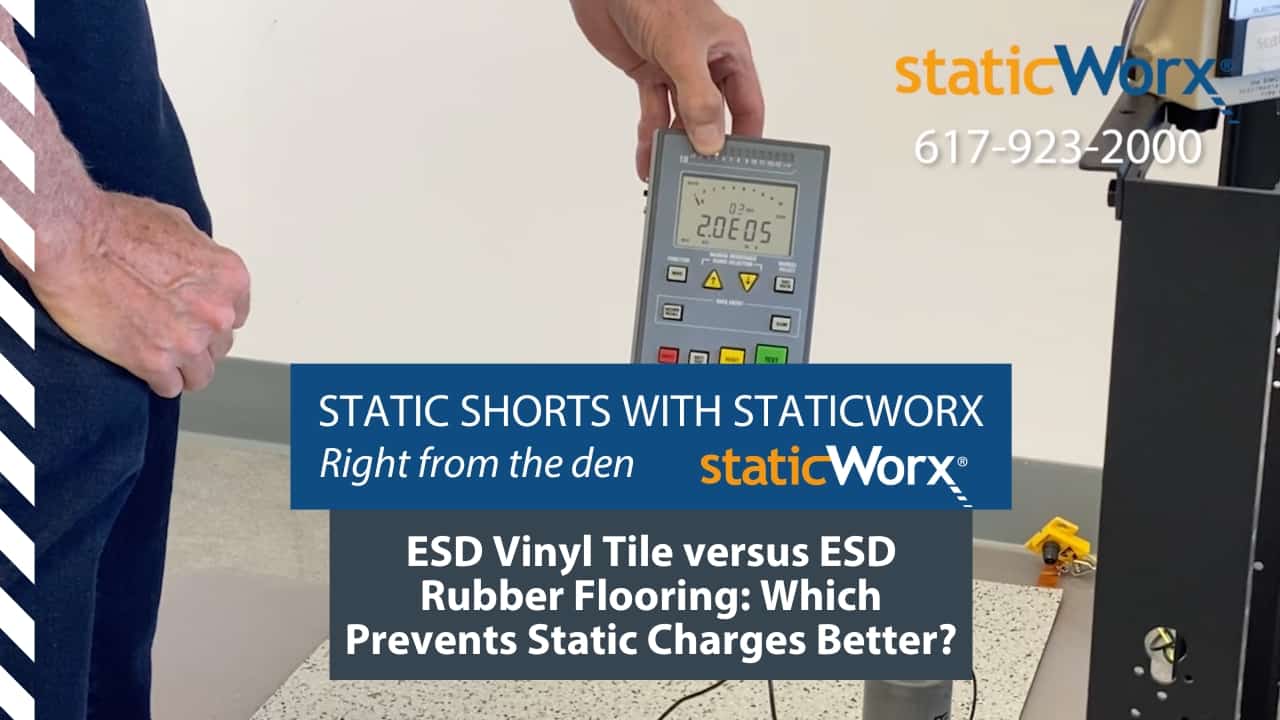
So what we’re going to start out with is we’re going to measure the electrical resistance of these two floors. This is a conductive vinyl floor. When I test this, I’m measuring a resistance of 3.4 x 10E5 from this probe to the groundable point. Now I’m going to move the probe to the conductive rubber floor and hit a reset button. And I’m measuring 2.0 x 10E5. So both of these floor tiles measure in the 10E5 range.

Now what I’m going to do, I’m just going to take this very simple static meter. And this needle is in the center, there’s no static electricity. And I’m going to scuff my feet. I’m going to lift my toes up off the floor and watch what happens when I do this. See that. Now I’m going to go to the rubber floor, I’m going to do the same thing. Big difference. Rubber conductive flooring does not generate as much body voltage as vinyl. In fact, it’s a factor of over 10.

So when you’re looking at flooring and you’re thinking about what’s going to happen when my people walk on the floor and they don’t have heel straps on, that’s the reason you want to gravitate towards a conductive rubber product instead of a conductive vinyl product. So resistance and body voltage don’t necessarily correlate. And I think that’s something you’ll read in many, many articles, but I’ve just shown you that today. Thank you.


Sign up for our newsletter and expert insights.

Related
ESD Flooring Selecting ESD Flooring

Why ESD Flooring for Mobile Equipment Requires More Than Floor Resistance

When specifying ESD flooring for mobile equipment in electronics manufacturing, aerospace, defense, semiconductor, and other high-reliability environments, electrical resistance is an essential performance consideration. But resistance measurements alone may not tell the whole story—particularly when carts, rolling workstations, conductive chairs, and automated equipment are part of the operation. The reason comes down to something surprisingly

Learn More
ESD Flooring Selecting ESD Flooring

How to Evaluate ESD Flooring Performance Beyond Resistance Testing

In Part One, we explored why resistance testing alone does not fully predict ESD flooring performance. Materials that test within the same resistance range can behave very differently once installed in operational environments. So if resistance is only part of the picture, what should architects, engineers, and facility teams evaluate instead? The answer is not

Learn More
ESD Basics ESD Flooring

ESD Flooring: Why Some Carpet Cannot Be Grounded

Today, Dave’s talking about conductivity and testing the electrical resistance of regular, static-dissipative, and highly conductive carpet.

Learn More
ESD Rubber Flooring

Don’t Choose Your Floor Until You Understand The Role of Footwear

Why Eclipse EC rubber flooring trumps other ESD resilient flooring options: Click here to learn more about Eclipse EC Flooring Information and Downloads Eclipse RubberBrochure Eclipse RubberCard Architectural SDRubber Rubber ProductsWarranty Further Reading Choosing ESD Floors for Cleanrooms ESD requirements for cleanrooms differ from other flooring applications. We offer tips and relevant technical details to

Learn More
ESD Rubber Flooring

Cleanrooms & Labs: Why We Love This ESD Flooring System

To Ensure Performance, ESD Flooring Must Be Evaluated as a System Because it integrates with both the building and personnel, ESD flooring, for any application, should never be evaluated as a standalone product. Neglecting to consider variables can result in a failed installation or a flooring choice that does not live up to expectations. To

Learn More
ESD Rubber Flooring

Advantages of Electrically Conductive (EC) Rubber

Eclipse conductive (EC) rubber trumps other ESD resilient flooring options Most static-control specifications over-emphasize the descriptors “conductive” and “static dissipative.” The terms are simply that: descriptors – and should not be used to specify ESD flooring (also known as antistatic flooring or static-control flooring). Flooring specifications should be based on measured resistance and charge generation,

Learn More
bg

Ready to Eliminate Static Risk?

When your facility’s protection depends on getting it right the first time, choose
the company with an unmatched track record. We’re standing by to assist you.