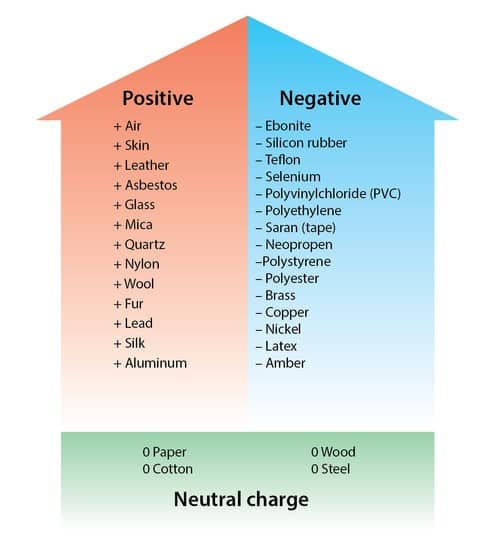
A list of common materials, such as leather, nylon, wool, and paper, showing whether a material tends to give up or take on electrons when in frictional contact with other materials on the list. Those that give up electrons become positively charged, and materials that accept electrons become negatively charged.
In the ESD industry, the triboelectric series is used primarily to predict resultant charge polarities after triboelectric generation.
Note: This series is only a guide. The list is derived from tests on specially prepared and cleaned materials tested in ultra-controlled conditions. In everyday circumstances, materials reasonably close to one another in the series can produce charge polarities opposite to expectations based on the series.