

Dave: Welcome to Static Talks. I’m your host, Dave Long, founder and president of StaticWorx. We make static control flooring. In our podcasts we’ll discuss the threat static electricity poses to your business and how to address these risks.
Rick: Dave, I understand that epoxy coatings have evolved quite a bit over the years. Could you tell us a little bit about the early days of ESD epoxy floors?
Dave: In the 1950s, the munitions industry had needs for conductive floors. And in certain cases, they liked the idea of a seamless epoxy floor because – picture a facility where they’re handling gunpowder. So, they’re making maybe blasting caps or some kind of detonators. They don’t want any crevices in the floor, where flammable and explosive materials can get lodged. Epoxy floors were a great solution for them. If it was circa 1955; your epoxy floor would be the same color as either carbon or graphite, so a deep gray color or a black color. And if you tested the flow with an ohm meter, the conductivity of that floor would be right on the surface. And if you needed to repair that floor, in most cases, you wouldn’t have to worry about cutting out the floor and starting down at the base at the concrete; you would just put another coating on top of the existing coding. So essentially, think about it as super hard carbon paint. And if it didn’t look good, or you needed to do a repair, you could just recoat the whole floor, you’d end up with a black or a very dark gray color.
Rick: I’m guessing the lack of options for different colors of ESD epoxy coatings left something to be desired. How did the proxy evolve from there?
Dave: When the requirements in the late 60s and 70s arose for using this in micro-electronics facilities and circuit board fabrication, these kinds of manufacturers didn’t want dark gray and black floors. They wanted their floors to be extremely light in color and very shiny. And that introduced what we call generation 2 technology, which is where a manufacturer would basically put down a primer on top of the concrete, after preparing the concrete, and that primer would have no conductivity. And then they would put down a middle layer, which would be just like the generation one floor. In fact, it was essentially the same material. So, they put down a middle layer which they call the conductive ground plane. And then on top of that, they will put a semi-conductive or honestly semi-dissipative top surface that had just enough carbon or just enough graphite. And because it was laminated or fused to this highly conductive carbon layer directly below the top surface. If you put an ohm meter on it, the voltage and current from the ohm meter would penetrate this beautiful shiny light-colored top surface and it would find the ground plane and you would get a resistance reading that met with NFPA requirements or with an ANSI/ESD requirements or with ASTM requirements for resistivity. So those floors for a long time were extremely popular.
However, let’s think about repair for a second, if we gauge a floor that requires a top layer married to a conductive layer underneath it, when we do the repair, we have to repair at the same time both layers. That means we’re starting now to have to cut the area out, put down probably the base primer again, because we’re probably going to cut too much, put down the black layer, and then put this top layer on top of it. And you do a repair of that type of floor, you have to be extremely careful about the thickness of the top coat. And the reason for that is, in order for those floors to provide the electrical resistance to ground that meets the specifications, they can’t be too thick. So, when you do a repair of these generation two floors, you’ve got this situation where you’ve really got to be careful about how thick the top coat is, which by the way is the reason why you can’t just repair the top coat. When you apply a second coat of top coat to a generation 2 epoxy floor, you go from something that measures under 10 to the ninth, if it was done properly, to something that probably measures 10 to the 11th which is two orders of magnitude out of specification.
Rick: So, the second generation introduced significant improvements to the floor’s appearance. But as we know epoxy coatings are subject to damage over time. And with three different layers, these coatings can be very difficult and costly to repair. How does the latest generation of ESD proxy coding solve this problem?
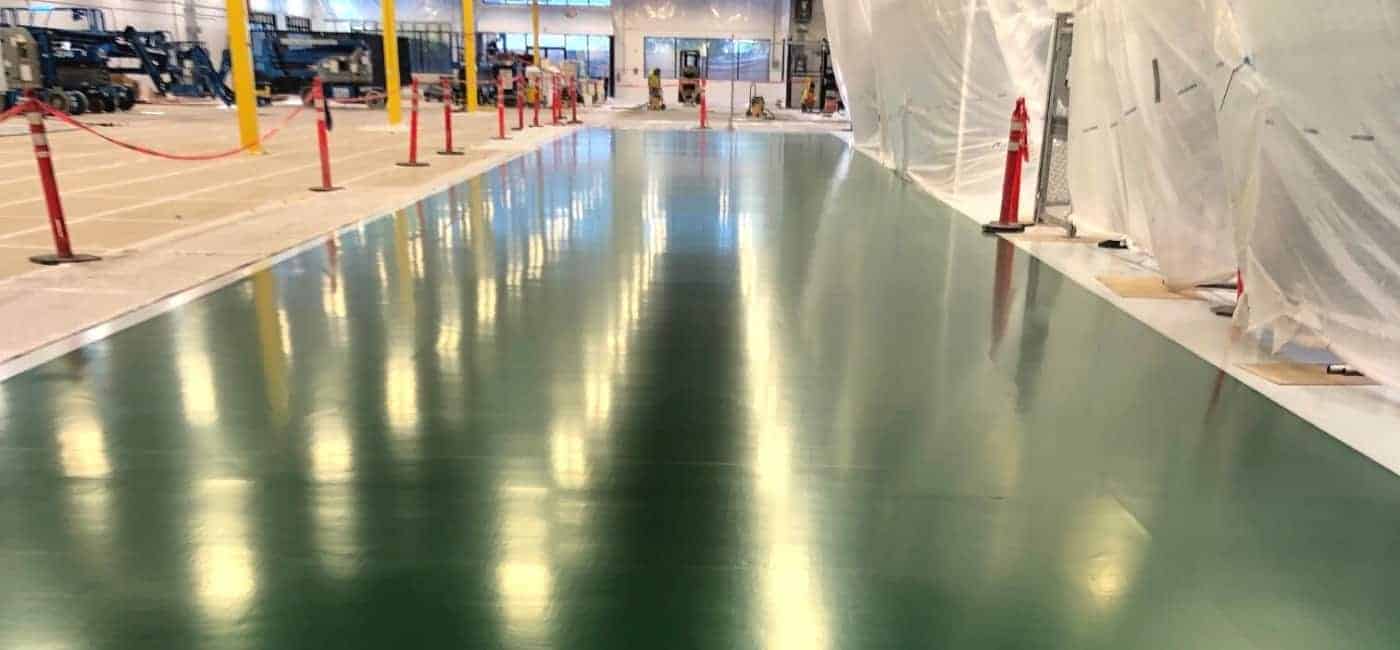
Dave: Generation three coating is basically a coating where the decorative layer in the conductive properties are all in one. By that I mean that the top coat is the conductive primer, is the shiny layer, is the attractive surface. And there’s not a lot of those types of coatings out there right now. It’s a little bit limited in terms of where you can find these coatings. But they work extremely well, because we’re no longer relying on applicators putting down the top coat at such a pre-determined thickness – which is very hard in a large manufacturing facility where if they put it down too thick, they don’t get what they want. If they put it down too thin, you see the black layer.
This generation 3 technology will greatly help with ESD performance. But more than that, if you damage the floor, based on some of the things we talked about earlier – movers dragging machinery over the floor, micro abrasions from chairs, all you need to do is lightly sand and by the way, if it’s a clean room, you can wet-sand the top coat, just put another top coat right down on top of it. That eliminates a lot of the issues with maintenance and repair.
We hope you learned something today. If you have questions about the podcast, give us a call at 617-923-2000. Even though we specialize in solving problems with flooring, if you have a question about static discharge, how to install a floor, how to test the floor, we’ll be glad to help you. Thanks for listening!