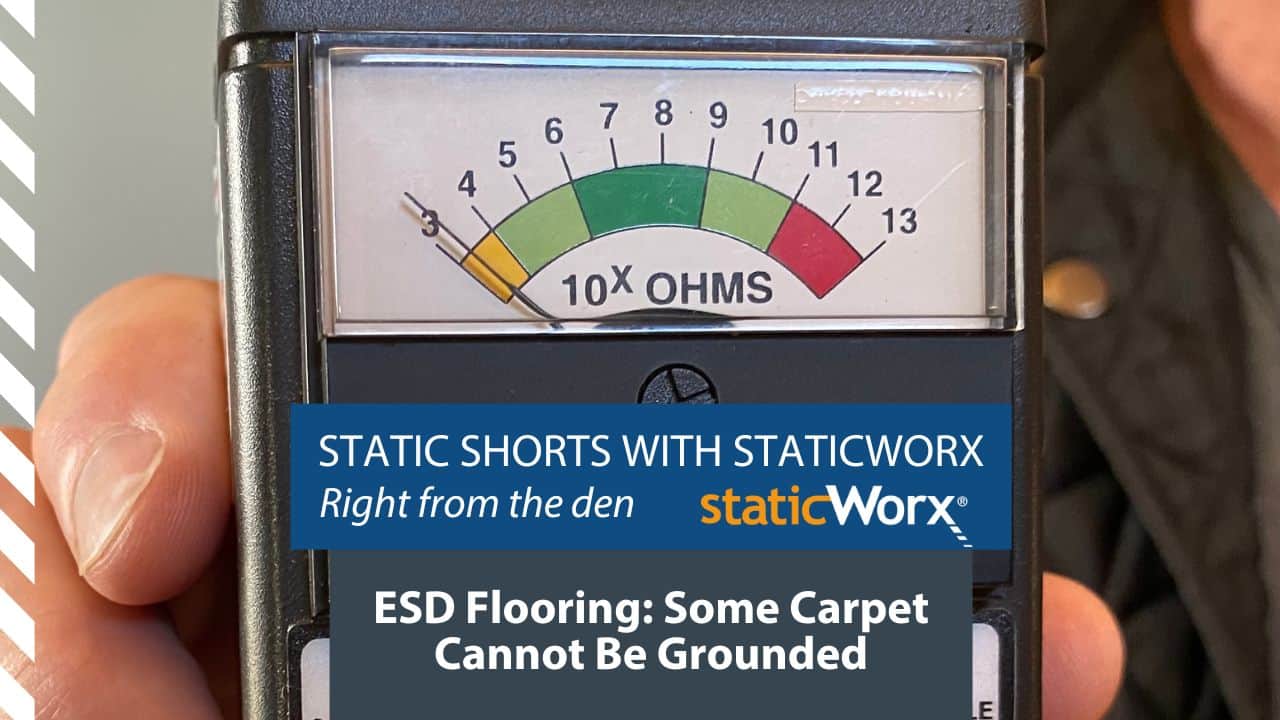
In this video, Dave Long – President and CEO of StaticWorx – busts the Low kV Carpet Myth wide open. Almost all commercial carpet is rated at or below 3.5kV (3500 volts.) The method for testing the kV generation of carpet was developed to inform consumers that their carpet will not cause nuisance static – aka static shocks. it is well documented that humans don’t feel static discharges below 3.5kV. Electronics systems, however, are sensitive to far less static than 1kV. Commercial low kV carpet products are not suitable for protecting electronics parts and systems and should not be confused with static dissipative carpet. Any commercial grade carpet on the market today is made to prevent or inhibit nuisance static.
To discover the ShadowFX ESD carpet lines that StaticWorx offers, browse our ShadowFX pages.
For help or advice about choosing an ESD floor, call us on 617-923-2000, email info@staticworx.com, or visit our Guide to ESD Flooring Selection.
Transcript
Low kV Carpet is Not Static Free

Low kV Carpet is Not Static Free
Hi, I’m Dave Long from StaticWorx. Like all of you, I’m stuck inside my house right now. I thought maybe a good use of time would be to review some basics about static control, particularly as it has to do with flooring.
So what we’re going to do today is banish a myth once and for all, called the low kV carpet myth. So what I’ve done is I’ve grabbed two carpet tiles. One of them is a static-dissipative carpet tile, which has a very dark back, because it has a lot of carbon in it and the exact same style as this carpet, I have a regular carpet tile. If you notice the color of the backing is a lot lighter than the other carpet tile. These are made in the same mill. One of them is for conventional applications and one is for static dissipative applications.
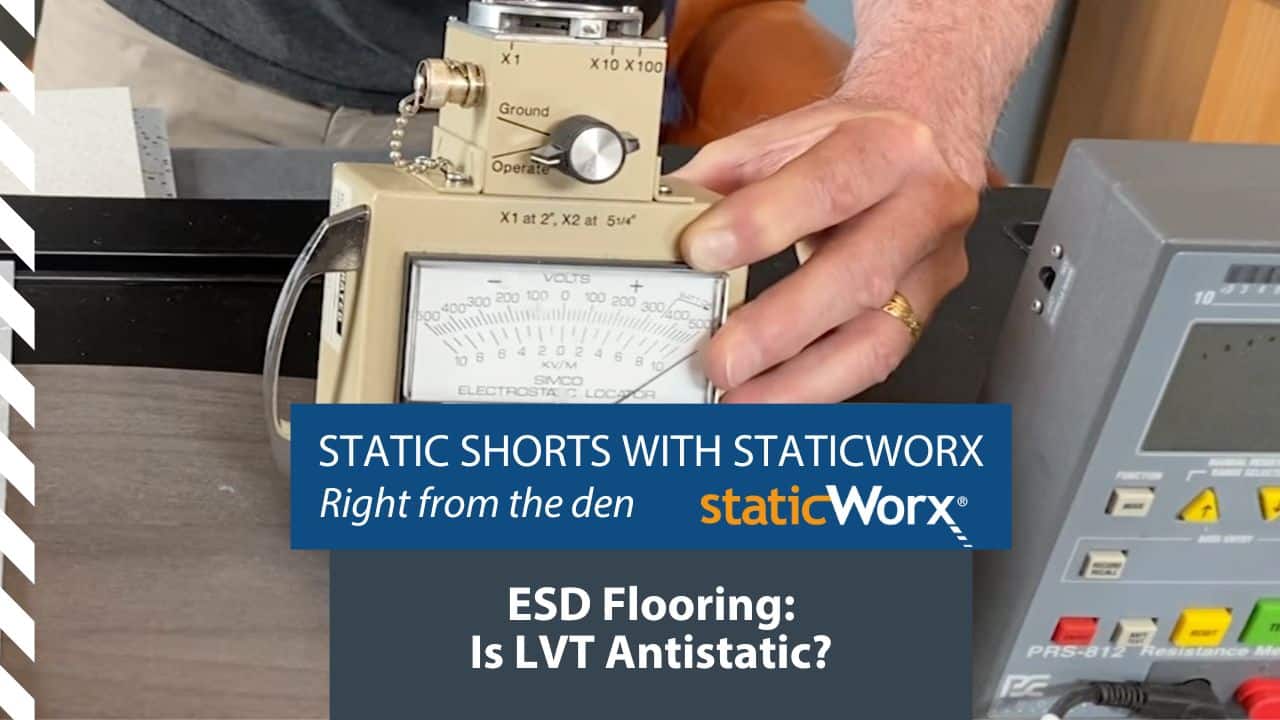
So what we’re going to do is we’re going to take my static meter, which if you look closely, it has a needle and when the needle is in the center that means there’s no static electricity. If it goes to the right, there’s a positive charge. If it goes to the left, there’s a negative charge. So I’m going to take the meter, going to set it up so all of you can see it. I’m going to charge up this metal plate, which even though it’s metal, won’t discharge to me because of this plastic handle. So you see all that static electricity that’s on the plate? So I’m going to take the plate and I’m going to touch it to this low kV carpet, conventional, commercial, low kV carpet. I think it’s two kV. Touch it. The charge didn’t go anywhere. Now I’m going to take it and I’m going to touch it to this static dissipative carpet tile. The charge is gone. Let’s do it again. This time we’ll start here. Plenty of static. Bring it here. Charge is gone.
One last thing I want to show you, there’s a rumor that certain types of LVT are low static generating. So I’m going to take the same metal plate and charge it up. And underneath my carpet tile I have a piece of LVT. This has a urethane finish, like a lot of LVT. I’m going to touch it to the LVT. The charge doesn’t go anywhere and you can see I can actually discharge it with my hand. One more thing about LVT, watch this. Not only can I not drain static electricity, but it charges objects that move on it. So don’t use LVT for static-control applications. Don’t think that because a carpet has a low kV rating that it might also be a product that can be grounded, because it can’t. Tomorrow we’ll do the same thing. We’ll meet here again and I’ll show you the electrical resistance properties of these carpet tiles. Thanks for listening.