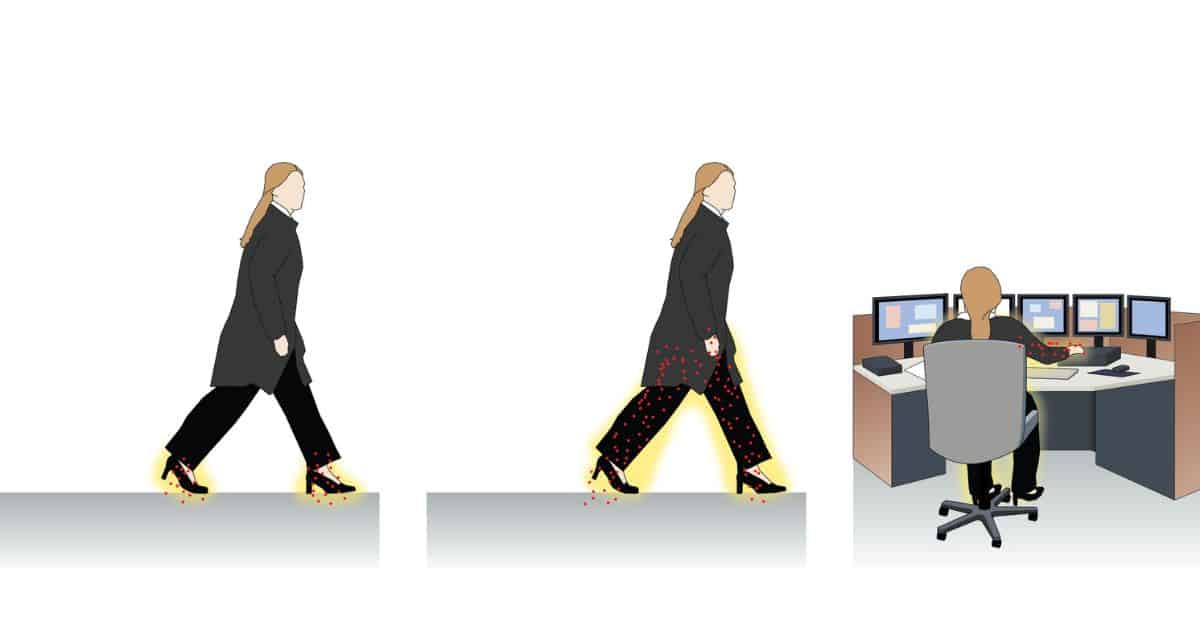
The term “antistatic” refers to a condition where an antistatic material inhibits static generation when it comes into frictional contact with another material. In ESD flooring terms, an antistatic floor inhibits static, or prevents some degree of static generation, when people walk on its surface.
Applied specifically to carpet, the term “antistatic” has a slightly different meaning. Antistatic carpet is a generic term and includes all carpet products that generate less static electricity than would be necessary for a person to get a shock after walking on it. Antistatic carpet is not necessarily conductive and cannot be grounded.*
The reason for specifying antistatic carpet is to establish a space that will be free of static shocks, or zaps.
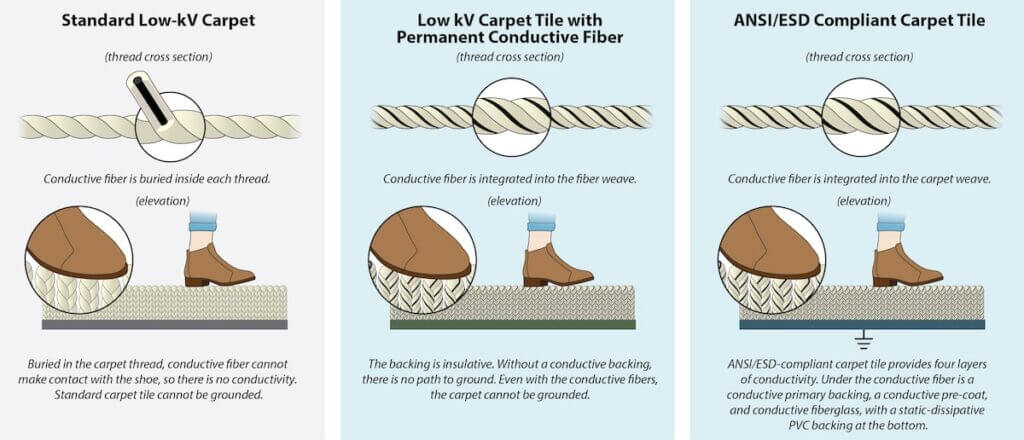
Antistatic carpet usually contains bi-component yarns and may be treated with a topical antistat. Most new antistatic carpet will prevent shocks as long as the relative humidity (RH) is above 25%.
Antistatic carpets do not offer permanent static protection and cannot ground static charges; for these reasons, they cannot protect sensitive electronic components. Antistatic carpet should NOT be confused with conductive or ESD carpet.
* Using conductive adhesive cannot ground this type of carpeting and cannot make it conductive (or static dissipative).
Learn more about StaticWorx ShadowFX static-dissipative carpet tile