
Dave: Welcome to Static Talks. I’m your host, Dave Long, founder and president of StaticWorx. We make static control flooring. In our podcasts we’ll discuss the threat static electricity poses to your business and how to address these risks.
Rick, when we were working with that ohm meter today reminded me of something that’s electrical safety. It’s a subject that no one likes to touch. And one of the reasons they don’t like to talk about it is because when you start talking about floors that have conductivity and that are grounded, at some point there is a question about whether or not a floor is too conductive and whether that would put a person in harm’s way. So I’m going to tell you a quick story. And I’ll tell you how we went about explaining it to the client.
We were called about a year and a half ago by an engineer from the FAA. They had just put in static control carpet in a flight tower and he tested it and it was far more conductive than their grounding standard allows for. And he said he called either the installer or the manufacturer. And he was told, all he needed to do was lift the tiles up and let the pressure sensitive adhesive dry more, put the tiles back down, and he would get a lower resistance to ground.
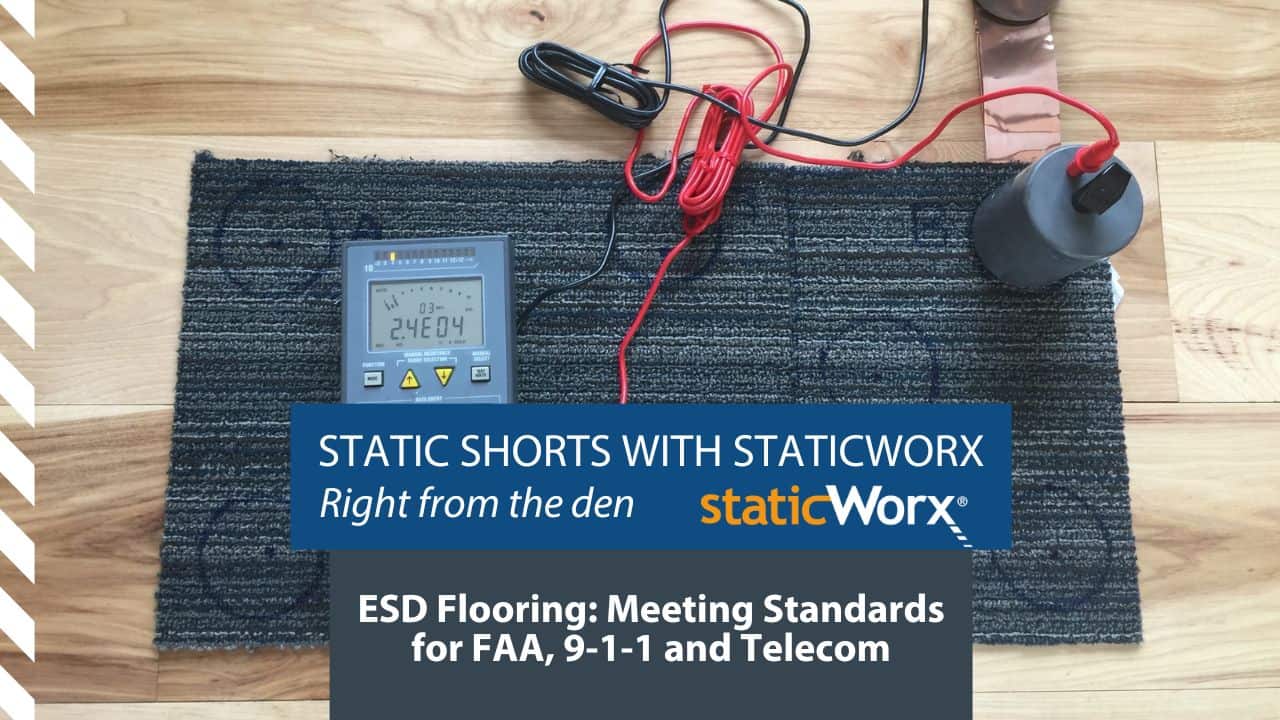
And for those of you who don’t know what resistance to ground is, what that is, it’s we take an ohm meter, we connect a probe to it, we put the probe on top of the floor, we connect the second lead on the meter to ground and we measure the electrical resistance from the carpet through the carpet to the adhesive to ground. So essentially this advice that was given to him was that the adhesive was too conductive. Not the carpet, but the adhesive, even though the reading of the carpet and the adhesive together was highly, highly conductive. So he did what he was told. He let it dry. And when he made that measurement, it did, in fact, raise the electrical resistance. And he was told that’s all you need to do. The reason I’m bringing this up is that’s basically a fake reading that is telling you something that defies logic, that prevents you from actually knowing whether or not you have a safe condition in your building. And I’ll explain why.
So, the FAA’s acceptable range for flooring is 10E6 to 10E9. This gentleman was getting 10E4. And he was getting that reading by measuring from, like I said, the top of the carpet to ground when he let the adhesive dry out. In other words, he let the adhesive lose a lot of its conductivity because it had moisture in it. Because it had moisture in it, he was able to get an acceptable reading to ground. However, had he taken the probes and put them on the surface of the tile, he still would have got an unacceptable reading. So, what he was told to do was to make something look good on paper.
Rick: So the FAA engineer was told to do the resistance testing in a way that produces the desired resistance reading. But this method does not provide an accurate resistance measurement of the flooring material itself. And so you could have a floor that is dangerously conductive on the surface. Even though testing of the whole flooring system, including the adhesive, produces a resistance reading that appears to be in compliance with FAA safety standards. This sounds like a bad idea with potentially dangerous consequences. What are the risks associated with overly conductive flooring in this type of environment?
Dave: When you populate a room with equipment, particularly a flight tower, you’ve got chassis, you’ve got blade servers, you’ve got racks that have metal feet that are electrically grounded because they’re electrical appliances. And when they get plugged in, the whole chassis becomes grounded. That would mean that anything that’s sitting on top of this floor would now be the new ground for the floor. Why would it be the new ground?
Because electricity flows to the path of least resistance. If the adhesive underneath it, even though it’s grounded, has a higher resistance, which it will, than the chassis, the chassis becomes the new ground. And now our floor goes from measuring over 10E6, to measuring close to zero, just by something interrupting the previous method of grounding it.
So when you look at an FAA document, one of the things they state is they want the floor to have a fair amount of electrical resistance. Because floors are used around what they call energized equipment. Energized equipment is nothing more than your laptop. Honestly, it’s your cell phone when you’re charging it up. So when I think about electrical safety, I’m not telling you that we can make people safe by providing floors with more electrical resistance than other floors. What I’m telling you is that if you don’t follow standards, you’re making people unsafe.
So please be careful in how you interpret what I’m telling you. What I’m telling you is, there are certain things that if you don’t follow the rules, you’re actually putting personnel, potentially, in a situation where they’re part of a dangerous electrical circuit. That said, I’ve never read and I’ve never heard of anyone getting electrocuted because of an ESD floor. But I also know that most engineers, most facilities people, architects and designers, their job is to do things, using best practices, not assuming liability that puts a customer in harm’s way.
Rick: Can you give us a real world example of something anyone can relate to, of the risk associated with having an overly conductive floor in a space that also has energized equipment in it?
Dave: We all on occasion use electrical appliances – hair dryers, things like that. We’re not afraid to hold a hair dryer in our hand drying our hair, standing on a dry floor. Would you ever want to do it while you’re sitting in a bathtub full of water? Well, that’s kind of what we’re talking about when the floor is too conductive.
We hope you learned something today. If you have questions about the podcast, give us a call at 617-923-2000. Even though we specialize in solving problems with flooring, if you have a question about static discharge, how to install a floor, how to test the floor, we’ll be glad to help you. Thanks for listening!