We’re back in the den with Dave Long today for another episode of Static Shorts with StaticWorx: Right from the den.
Today, Dave’s talking about meeting government standards and looking at three key standards: Motorola R56, ATIS 0600321, and FAA 019f. Although these standards are from three different organizations, there is consensus across the three so be sure to test extensively to be sure you’re meeting the requirements.
The reason I chose these three standards is these three standards govern the specifications that should be written for most applications for flight towers, server rooms, comm centers, command centers, 9-1-1 call centers, and the nice thing about these three standards is even though they come from three different organizations, there’s definite consensus within them.
According to the National Emergency Number Association, in the U.S. alone, more than 240 million 9-1-1 calls are placed each year. In a 9-1-1 dispatch center—and other mission-critical spaces, such as FAA flight towers, data centers, server rooms, critical-call centers, and networked government offices, such as Social Security, the IRS or Homeland Security, to name just three—static electricity can wreak havoc. In worst case scenarios, electrostatic discharge (ESD) can result in lost calls or misdirected traffic, putting human safety at risk.
Transcript
ESD Flooring: Meeting Standards for FAA, 9-1-1 and Telecom

ESD Flooring: Meeting Standards for FAA, 9-1-1 and Telecom
Hi, I’m Dave Long from StaticWorx. Today is April 10th, Friday. My third video this week. I’m still in lockdown. Hopefully, by the time some of you watch this, it’ll be a thing of the past.
The purpose of today’s video is to explain meeting standards for mainly government and safety applications. When I talk about standards today, what I’m actually talking about is Motorola R56, ATIS 0600321, and FAA 019f. The reason I chose these three standards is these three standards govern the specifications that should be written for most applications for flight towers, server rooms, comm centers, command centers, 9-1-1 call centers, and the nice thing about these three standards is even though they come from three different organizations, there’s definite consensus within them. So we’re going to look at these standards, and we’re going to look at these three carpet tile materials through the eyes of an ohm meter.
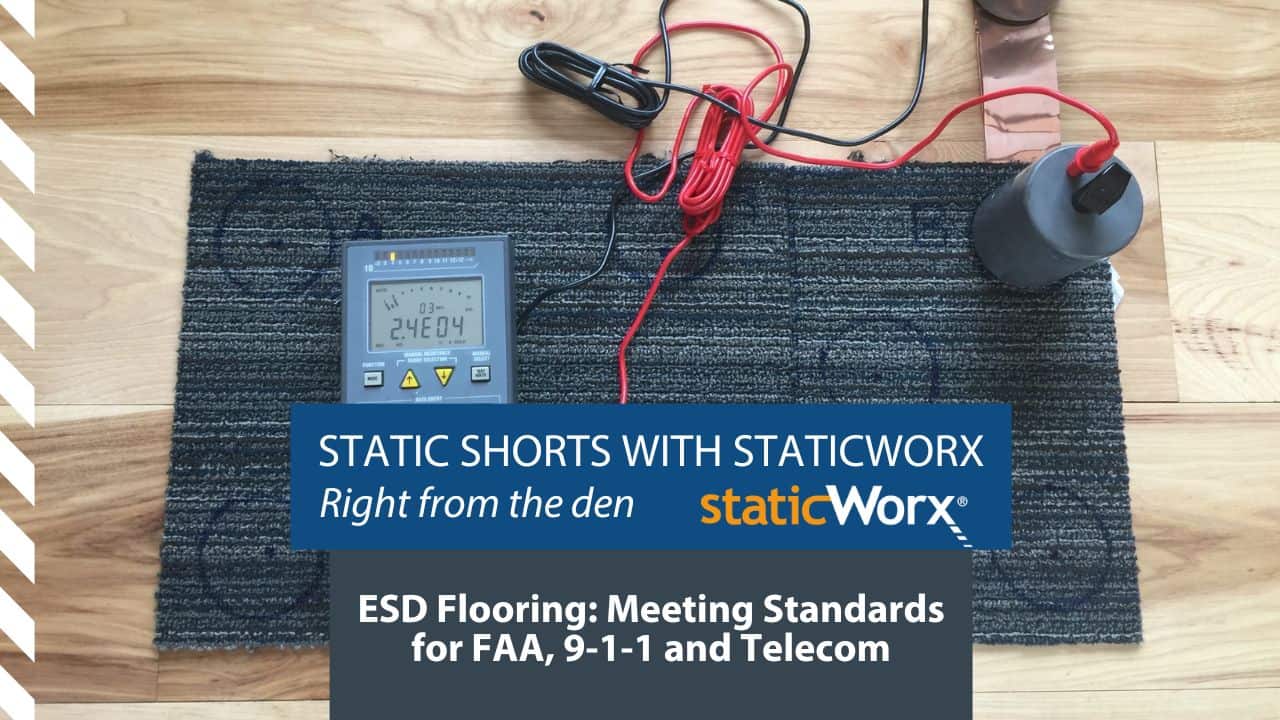
So what this meter does is it measures electrical resistance in ohms through these two connections to these two probes. And these probes, what I’m going to be doing with them is placing them on these three types of carpet, which are all connected electrically through a piece of copper. So let’s start by looking at a material that has a black back on it. I’m going to take the probes, place them on the carpet, and if you notice, I’m measuring between four and five. So all these numbers on this ohm meter are reflecting in order of magnitude. So when I say four, I’m actually talking about 10 to the fourth (10E4). When I say five, I’m talking about 10 to the fifth (10E5). So this particular piece of carpet is measuring between 10,000 and 100,000 ohms. And that’s an important number because those three standards I just told you about, they’re telling you, as a specifier and an end user, that you want your floor to measure between 10 to the sixth (10E6) and no more than 10 to the 10th (10E10). So 10 to the fourth to 10 to the fifth is well under meeting the needs of a particular standard that you need to be referencing.
So let’s test a second piece of carpet. This piece of carpet has a very light backing, and I’m going to just explain to you that there’s no carbon in this carpet. So it’s very unlikely that this carpet would ever be used to meet these standards, but I want you to see the difference. So when I put the probes on it and I measure it, it’s measuring well over 10 to the 10th (10E10). That means that this piece of carpet is measuring well over 10 billion ohms, almost 100 billion ohms. And remember, this one was measuring between 10,000 and 100,000. So this one was well under acceptable for these standards. This one is way over the acceptable number of ohms resistance.
Here’s a third piece of carpet. If you notice, this one has a kind of a dark back compared to the one I just showed you. This one has carbon in it. When I place the two probes on this piece of carpet, I’m measuring between 10 to the seventh (10E7) and 10 to the eighth (10E8). If you recall in the standards, they want the floor to measure between six and nine. It’s right in the middle. For those of you who are Goldilocks fans, this is the sweet spot. This is not too hot like this one and not too cold but just right. So to recap, if it has a black back, it’s too conductive. If it has a very light backing, it’s not conductive enough. If it’s got carbon in it but not as much carbon as this one, it meets the standard.
And by the way, I’m not asking you to visually test your floors. Anytime you write a specification, you should be referencing these standards, and you should be asking whoever supplies you with the floor or whoever installs the floor to perform this test afterwards. And this test should be done on the surface of the floor, on the surface of the floor to ground, within a tile, across two tiles. There’s a whole series of tests, and there’s a test method for this, and if you write your specification properly, you’ll actually get what you want and you’ll meet the standards.
So thank you very much. If you have more questions, you can go online and you can actually look up these standards yourself, Motorola R56, FAA 019f, ATIS 0600321. You can call Staticworx, or you can call an engineer who understands the problem and knows how to write specifications. Thank you.