

Dave: Welcome to Static Talks. I’m your host, Dave Long founder and president of Staticworx. We make static control flooring. In our podcasts we discuss the threat static electricity poses to your business and how to address these risks.
If we’re going to talk about the cost of a floor, one of the things we really do need to talk about is not only the cost of taking care of the floor, but I guess you might say how long it lasts while it’s still visually appealing. So let’s look at how carpet is made. So when we look at carpet, the first thing you want to look at is the construction of it, because the construction of it is going to tell us how long it lasts and what we can do to make it last longer. So carpet tile is comprised of a section of layers of material. You’ve got your nylon tufts, which is your walking surface. Below that you’ve got layers that involve fiberglass.
You’ve got a coating that holds materials together; you’ve got a backing. So you’ve got these different materials that are laminated together. So what are we looking at and we look at carpet, and we look at whether or not it’s time to replace it. Usually we’re looking at the top surface, the nylon tufts. So unfortunately, when people look at carpet, what they look at is what it looks like brand new in a book or in a sample, or maybe if it’s a large purchase, you have somebody come in and put a mock up down of an area that’s 10 foot by 10 foot; that tells you whether you like it or not, when it’s new. It doesn’t tell you what it’s going to look like after it’s been used for a while. And that’s really what you should be caring about.
Rick: So one of the hidden costs associated with ESD carpet is replacing areas that are either worn or damaged. What are some attributes to consider that will help to reduce this cost over time?
Dave: So when we analyze carpet, what we really want to do is we want to start by analyzing the actual fibers that make up carpet. So the first thing I’m going to tell you, if you’re evaluating carpet, is you want the fiber to be made by a different company, than the carpet company. Why? Because fiber is actually an extremely complex engineered material. Ask where the fiber is made. If the fiber is made at the mill, the reason it’s made there is it costs less money than to buy a fiber from outside.
So when we start looking at fiber, first we want to look at is the geometry of the fiber. And there’s a metric that some carpet manufacturers actually reveal and some carpet manufacturer don’t. And it’s called the modification ratio. And essentially, the modification ratio has to do with the geometry of the fiber. And by geometry, what I’m talking about is the shape of it. Certain shapes of fiber have the ability to withstand traffic and not retain contamination as much as other shapes. And they have a metric for this. And the metric has to do with the size of the core versus let’s call it the outside circumference.
That ratio, ideally should be the number two or less. So if your carpet that you’re evaluating doesn’t have a modification ratio, ask. If you hear, “we don’t need to provide that information,” walk; that means that the information isn’t good. Because if someone has a metric that is outstanding, they’re going to tell it; if they don’t, they’re going to hide it. So that’s kind of the starting point. So good fiber manufacturers produce fibers that have a modification ratio of something in the order of 1.6 to maybe 2.2 at the highest. So because we’re talking about here hidden costs, that’s a hidden attribute – or hidden cost – depending upon which way your decision rolls and which modification ratio you end up with.
Rick: So the nylon surface of the carpet should be produced by a specialty manufacturer and should have low modification ratio to stand up to heavy traffic. Are there other factors to consider that will help to keep ESD carpet looking good for many years?
Dave: Okay, the next element that I would be looking at when I evaluate carpet for the kinds of spaces where ESD is a problem is the design or what you might call the pattern of the carpet. So pretend for a minute that we like a very streamlined, clean looking space. We want the carpet to be a solid color. want it to look like one monolithic perfect room. Great. When you first put the carpet in that room that it will look exactly like I just described.
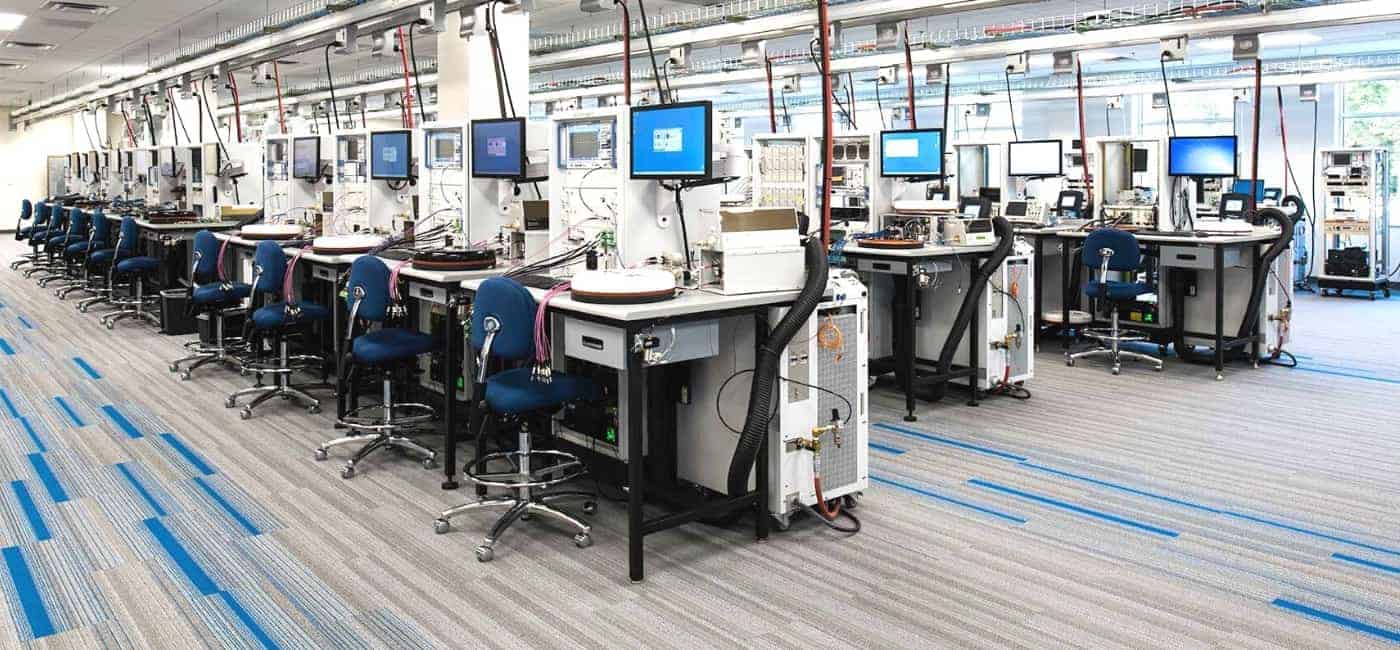
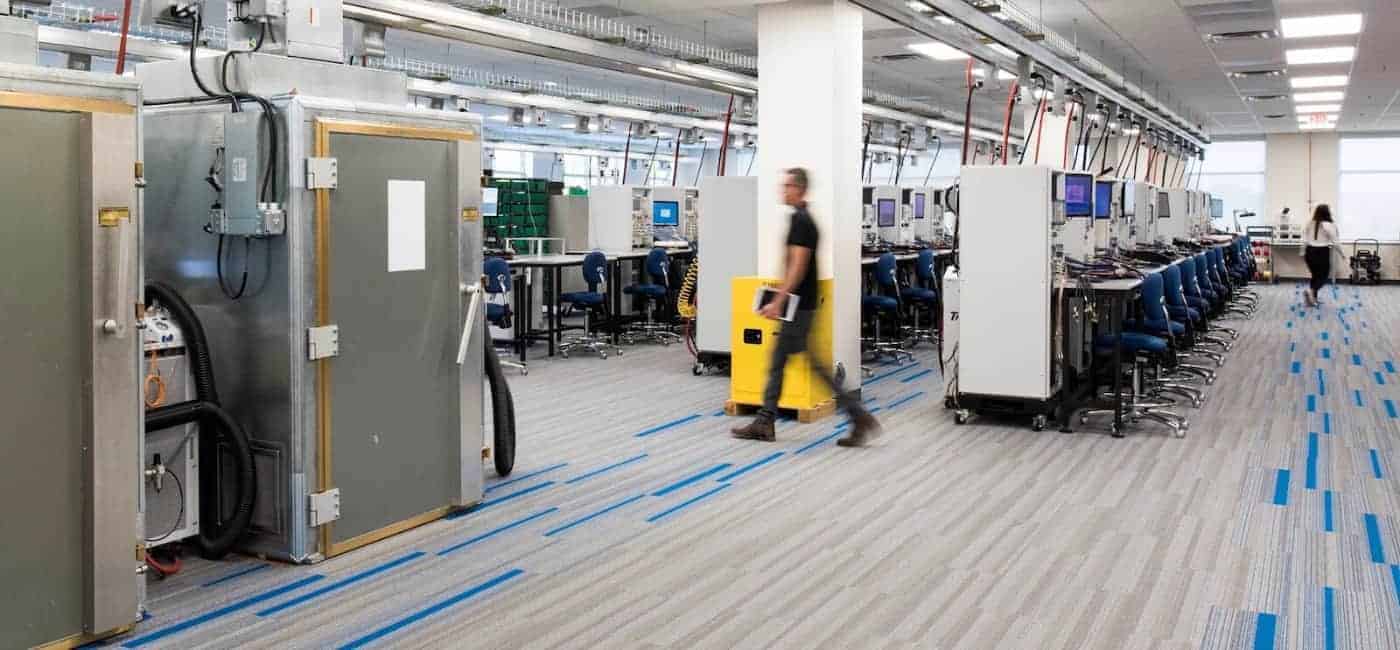
However, if you subject that room to the kind of traffic that let’s say, a 24 hour call center might subject it to, or maybe you’re going to use it in a facility where you’re building circuit boards where people spend a lot of time on their feet. What you’ll discover is wherever people walk, the carpet is going to look a little bit different. May not be worn out. It’s going to look a little different than where people don’t walk. In the call center wherever the chairs are, because chairs are on casters and they roll, you’re going to have big circles in the carpet. And there’s going to be no way to hide that because it’s a solid color. So anything you do to a solid color in one point if you don’t do it in the adjacent point, there is going to be a line of demarcation. So I never advocate using solid colors. Because once you buy into the solid color, you’re buying into a shorter visual life for any carpet. So at the very least if you like solid colors, you should be looking at something that has somewhat of a sculpted pattern.
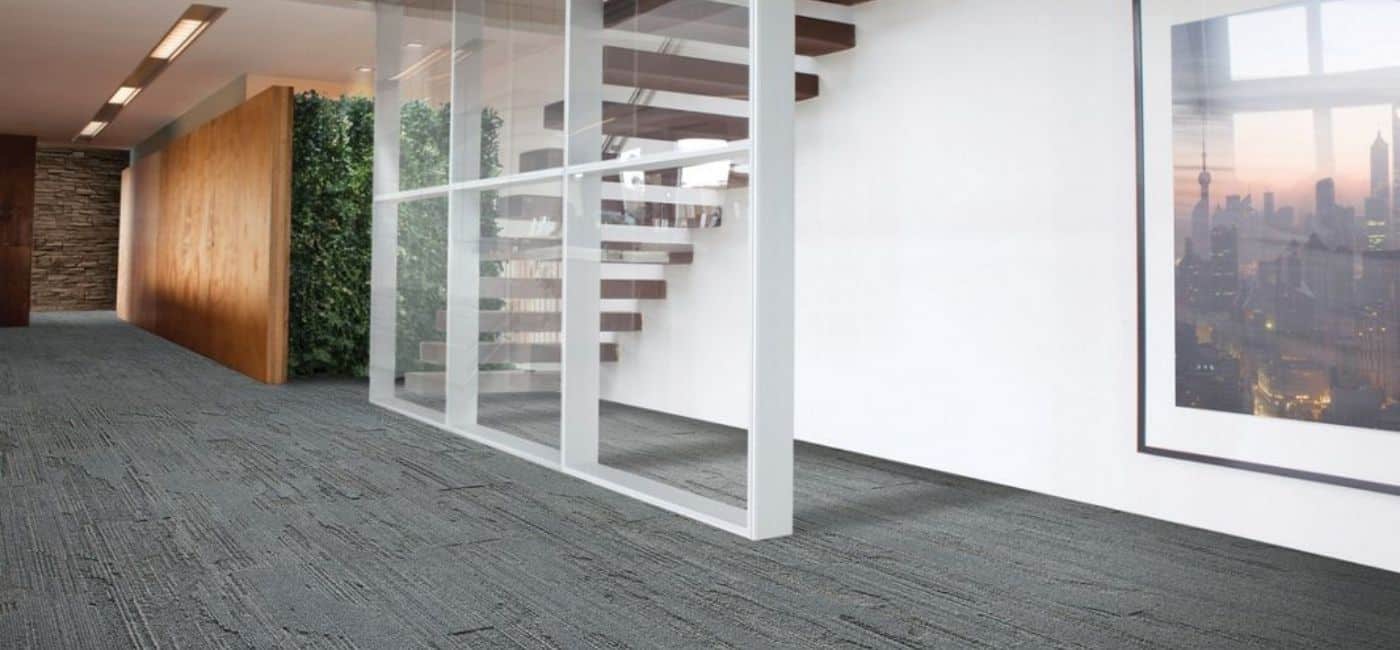
With a random non-directional carpet, I can put these carpet tiles down in any orientation I want, and not have to feel like I’ve upset the look of the installation; if anything, I’ve contributed to the advantage of doing it that way. So another hidden cost is when you look at fibers, and you look at carpet, you want to be looking at it from the perspective of – can I install it in such a way with such random placement that I can’t tell one tile from another; I can’t see the seams; and because of that I can’t see the wear patterns. So that’s a second attribute that you want to evaluate.
I guess the next thing to think about – and this is definitely a hidden cost – is there a way for me to install them where I can move them easily, I can repair them easily. And there are methods of installing ESD carpet tiles that allow for no glue whatsoever. So one of the methods that we employ, we use a device made by one of the companies we work with called the tactile. That allows me to basically lock the whole floor together, but not have to use any adhesive. It all comes down to employing a strategy, where you’re thinking about five years from now, you’re not thinking about how pretty it is today. Because another hidden cost in most of these spaces is, because they’re 24/7, if I have to replace the floor prematurely, my real cost isn’t even the floor. My real cost is handling the disruption of the operation.
We hope you learned something today. If you have questions about the podcast, give us a call at 617-923-2000. Even though we specialize in solving problems with flooring, if you have a question about static discharge, how to install a floor how to test the floor we’ll be glad to help you. Thanks for listening.