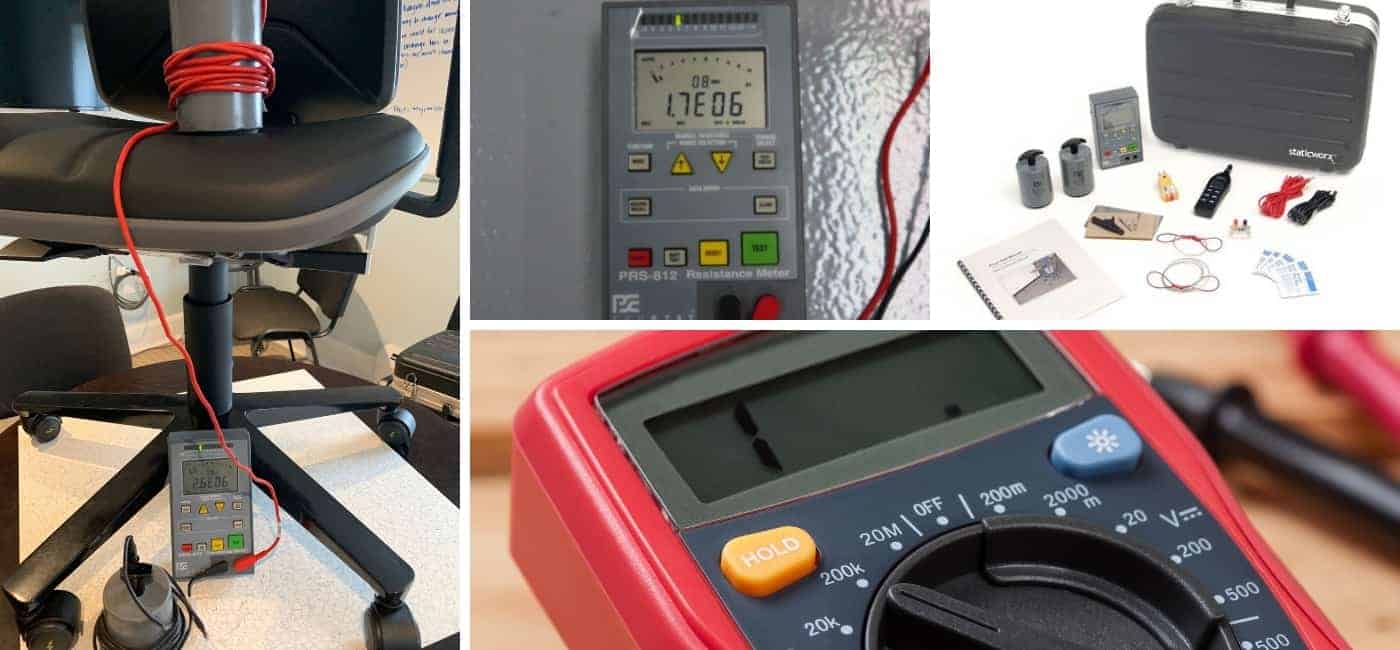
ESD Flooring Standards – Grounding and Charge Generation
Will low kV or antistatic commercial carpet protect my electronic equipment?
The short answer is, no. Low kV – also called office or computer-grade – carpet is intended to inhibit nuisance static charges. So when you walk across a low kV carpet, you won’t feel a static shock. However, low kV or computer-grade carpet does not dissipate static electricity and cannot be grounded. Protecting electronic equipment requires a much greater reduction in static than the anti-static treatments commercial carpets provide. This is true whether components are used or housed in an electronics manufacturing or handling facility, data or critical call center, 9-1-1 dispatch operation, or flight control tower – or any space where damage to electronic equipment would compromise the core mission.
Buried in the carpet thread, conductive fiber cannot make contact with the shoe, so there is no conductivity. Standard carpet tile cannot be grounded.
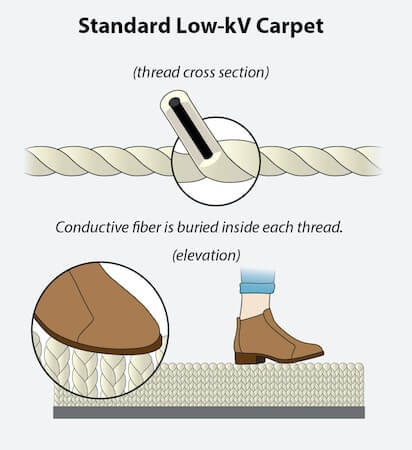
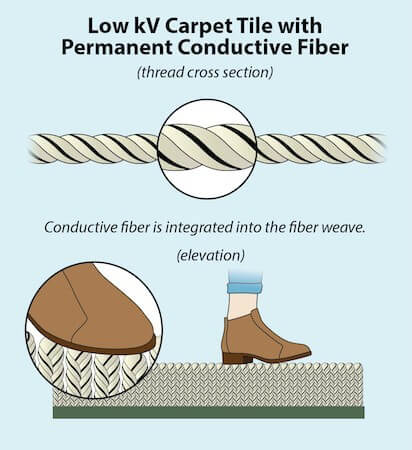
The backing is insulative. Without a conductive backing, there is no path to ground. Even with the conductive fibers, the carpet cannot be grounded.
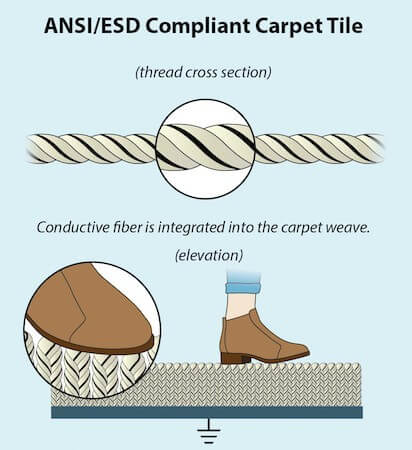
ANSI/ESD-compliant carpet tile provides four layers of conductivity. Under the conductive fiber is a conductive primary backing, a conductive pre-coat, and conductive fiberglass, with a static-dissipative PVC backing at the bottom.

ESD Flooring Qualification by Industry Standards
ESD flooring should never be qualified or specified based on descriptors like conductive or dissipative. Always qualify and specify ESD flooring based on industry-specific static-control standards such as ANSI/ASTM, ATIS, Motorola, FAA , DOD, or other industry- standards.
Electronics Manufacturing and Handling Applications
ESD standards for grounding and charge generation vary by industry. For electronics manufacturing and handling facilities, where all personnel are required to wear special ESD-protective footwear, specifications should be based on ANSI/ESD S20.20.
ANSI/ESD specifications reference test methods ANSI/ESD STM 7.1 and STM 97.2.
ESD flooring standards for electronics manufacturing and handling:
- Resistance, measured in ohms, per STM 7.1:
- < 1.0 x 10E9 ohms
- Charge generation, measured in volts, per STM 97.2:
- < 100 volts at peak
FAA, 9-1-1 Dispatch, Telecom Applications, Control Rooms, Data Centers and Other End-user Spaces
Floors for end-user spaces where electrified equipment (electronics or computers) is in use, refer to industry-specific standards: e.g. Motorola R56, ATIS-0600321, for telecom and dispatcher spaces, FAA 019f for FAA flight towers, Army Corps of Engineers, Spec #: UFGS 09 62 38, for construction of military services, etc.
ESD flooring standards for most government applications and end-user spaces:
- Resistance, measured in ohms, per STM 7.1:
- 1.0 x 10E6 to 1.0 x 10E10
- Charge generation, measured in volts, per STM 97.2:
- < 500 volts (.5 kV)
Please note: because environmental conditions (e.g. dirt or low humidity) can increase electrical resistance, StaticWorx recommends resistance < 1.0 x 10E8
Explore Our ShadowFX Collections




ShadowFX Carpet Tile and ESD StandardsFrequently Asked Questions
Is ShadowFX carpet tile conductive or static dissipative?
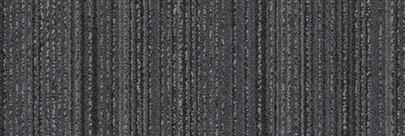
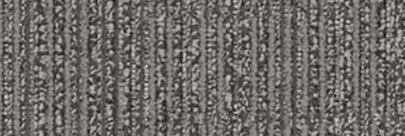
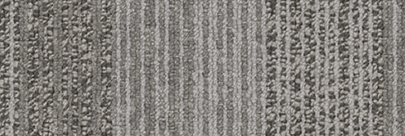
ShadowFX carpet tile is static dissipative, measuring between 1.0 × 10⁶ and < 1.0 × 10⁹ ohms when tested at 100V per ANSI/ESD STM 7.1. This allows static charge to flow safely to ground at a controlled rate.
Why won’t low-kV or antistatic commercial carpet protect electronics?
Low-kV (office-grade) carpet is designed only to prevent nuisance shocks to people, not to dissipate static electricity. It cannot be grounded and does not provide the level of charge reduction required to protect sensitive electronic equipment.
Why can’t standard carpet tile be grounded?
Standard carpet tile lacks a continuous conductive path. Conductive fibers are buried in the yarn and cannot contact footwear, and the backing is typically insulative—preventing electricity from reaching ground.
What makes ANSI/ESD-compliant carpet different?
ANSI/ESD-compliant carpet tile provides multiple conductive layers, including conductive fiber, conductive primary backing, conductive pre-coat, conductive fiberglass, and a static-dissipative PVC backing—creating a complete, groundable system.
Which standards apply to electronics manufacturing environments?
For electronics manufacturing and handling facilities where personnel wear ESD footwear, flooring specifications should align with ANSI/ESD S20.20, referencing test methods ANSI/ESD STM 7.1 and ANSI/ESD STM 97.2.
What standards apply to data centers, 9-1-1, FAA, and telecom spaces?
End-user spaces typically follow industry-specific standards such as Motorola R56, ATIS-0600321, FAA 019f, or UFGS 09 62 38. These environments allow higher resistance ranges and charge limits than electronics manufacturing, but still require controlled static performance.
What Clients are Saying

…the floor is awesome! It’s very durable and it’s very convenient that we can lift tiles up to remove debris from underneath, and even replace tiles if they are damaged. So from a functional perspective, this is the best floor for our manufacturing operation.
You would never know it was ESD, WHICH IS AMAZING! Your product rocks and I’m so glad we were able to find an attractive solution that didn’t leave us with some run-of-the-mill ugly disaster in the middle of our workspaces!
Your product is impervious to most/all conditions. It’s impressive. Happy to be working with StaticWorx.

Ready to Eliminate Static Risk?
When your facility’s protection depends on getting it right the first time, choose
the company with an unmatched track record. We’re standing by to assist you.
Static-Control Education at Your Fingertips
Explore the StaticWorx Knowledge Center for technical articles, videos, and guides to help you specify, install, and maintain ESD flooring with confidence.