Can GroundLock Extreme tiles be installed over carpet?
GroundLock is an ideal ESD floor—also known as an antistatic or static-control floor—for placement over old low-pile carpet. Installing over old carpet allows the user to create an ESD safe area in a leased space without permanently altering the building.
Can GroundLock tiles go over raised flooring?
Yes. GroundLock Extreme lay-flat tile is an excellent choice for raised flooring installations. It can be picked up using a suction cup.
Can I put GroundLock Extreme over my current subfloor?
Yes. While depending upon the condition/flatness of the old floor some corrections may be required, GroundLock can be installed over any subfloor, often with no floor prep.
Can GroundLock interlocking tiles be moved?
Yes. One of the big advantages of GroundLock Extreme interlocking tile is that it is easily picked up and moved to a new location. Simply loosen or pry up an edge, lift the tile, and carry away.
Can GroundLock tile handle heavy weight like pallet jacks?
Yes. GroundLock is engineered to withstand heavy rolling traffic and high distributed weight loads from equipment such as pallet jacks and forklifts without cupping, warping, or distortion. However, point loads (concentrated weight on small contact areas) differ from overall weight loads. Ask StaticWorx how this applies to your application.
Can you tell us some places where GroundLock has been installed?
Several OEM producers of modular buildings use GroundLock as a building standard. Other installations include: Advanced Motion Controls in California; L3 Harris – multiple locations; Randolph AFB; Jabil; Magna Electronics; Benchmark Space Systems; General Electric; Miltec; Mini-Circuits; Sandia Labs; Amazon; BorgWarner; Macom; Ritron Wireless Solutions; and Crane Aerospace.
Do I need copper wire under all the tiles?
No. A copper strip is installed under a single tile – usually at the perimeter of the installation. The strip is attached to an AC outlet or other type of earth ground. Installations require one copper strip per 1000 sq.ft of flooring material.
Does GroundLock ever lose its ESD properties?
GroundLock is intrinsically conductive. Conductive elements are introduced in the manufacturing process, so GroundLock will never lose its conductivity. GroundLock Extreme interlocking and lay-flat tiles come with a lifetime warranty for conductivity/static control.
Does GroundLock interlocking ESD tile require glue?
GroundLock Extreme interlocking ESD tile does not require glue. Interlocking tiles have dovetailed edges that lock into place like puzzle pieces. Simply lay the tile and tap into place with a rubber mallet.
GroundLock Lay-flat tile is the same tile as our GroundLock Extreme with the dovetails removed. This version is made for placement over raised access floors for applications where the floor will be picked up and put back in place regularly.
Because GroundLock is made with a fiberglass inner layer, the square tiles sit flat but loose on top of the raised panels for easy movement when the end user needs to gain access to the plenum under the floor.
Does GroundLock require moisture testing?
Because it does not require adhesive, GroundLock Extreme interlocking and lay-flat tiles can be installed directly over subfloors without testing for moisture.
How do you clean it?
The surface of GroundLock is prepared with a proprietary laser process to prevent the penetration of soil and dirt. It never needs waxing for any reason. GroundLock requires only soap and water to clean.
How does it get installed?
GroundLock Extreme interlocking ESD tile has dovetail edges that lock into place like puzzle pieces. You simply lay the tile and tap into place.
How is the durability? Does it hold up to fork trucks and other heavy equipment? Does it mar and scratch easily? Does it ever need wax?
GroundLock is manufactured with a non-porous sealed surface. Markings from traffic, cart wheels and pallet jacks will not embed into the surface.
GroundLock is an extremely durable material. It easily handles heavy load movement with pallet jacks and fork lifts. If you fast-forward 1 minute and 30 seconds, into the video you below, you can see our durability test. We are also happy to provide the results of independent ANSI/ESD S 20.20 test reports done by a third party in 2022.
How much attic stock do I need?
Most clients keep a very small amount of tile in the event that a tile is damaged from the nails in a pallet that has been dragged over the floor.
If we take the tiles apart, does the process of taking them apart ever damage them?
No, these tiles are meant to be redeployed as needed. We work with military shelters who are doing this weekly.
In the wire harness area of our facility we have only one wall to connect to ground. Is that enough, even with some of the tile being 70 feet away?
Standard practice is to have one ground connection per 1000 sq.ft. installation. In the unlikely event that you have no access to more than one ground point, we have an equipotential solution for you. For more information, contact your StaticWorx rep: 617-923-2000.
Is it easy to replace a GroundLock tile?
Yes. To replace GroundLock Extreme interlocking ESD tiles, simply pry up one end of the damaged tile, lift up and out, then tap a new tile into its place.
Is there a good way to get the seams to disappear completely and also make sure the tiles are completely flat? We used a mallet to pound together the two tiles you gave us and they have some ridges. Over time do the tiles ever slowly become unattached?
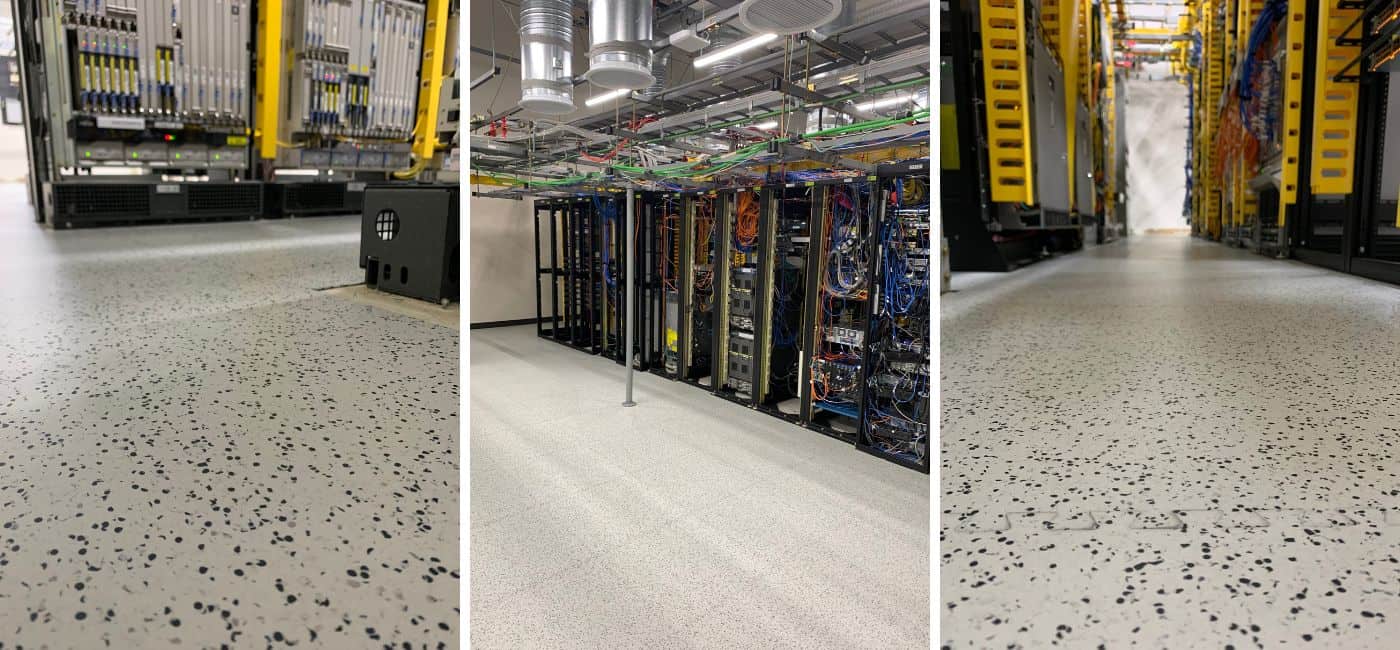
One of the attributes of this floor is that it lays extremely flat even on subfloors that are not perfectly even. Below are some photos from a server room at Cox Communications. Their building had a very uneven subfloor with moisture problems. As you can see from the photos, the GroundLock tiles are completely flat.
With regards to seams, you will see seams. Medium gray is our most popular color and we will tell you that the seams blend and are far less visible with that color.
What is GroundLock Extreme's lead time?
GroundLock is always in stock unless the order requires a very large quantity.
What’s the difference between the dovetail and lay flat version?
The materials are the same. Both interlocking and layflat tiles are 6mm thick with a fiberglass center for strength and dimensional stability. The dovetail version has finger-type edges that fit together like puzzle pieces. So you simply lay the tile and tap into place. The lay-flat version has the dovetails removed. Like any vinyl tile, the square layflat version can be adhered to the subfloor and seam welded.

Ready to Eliminate Static Risk?
When your facility’s protection depends on getting it right the first time, choose
the company with an unmatched track record. We’re standing by to assist you.