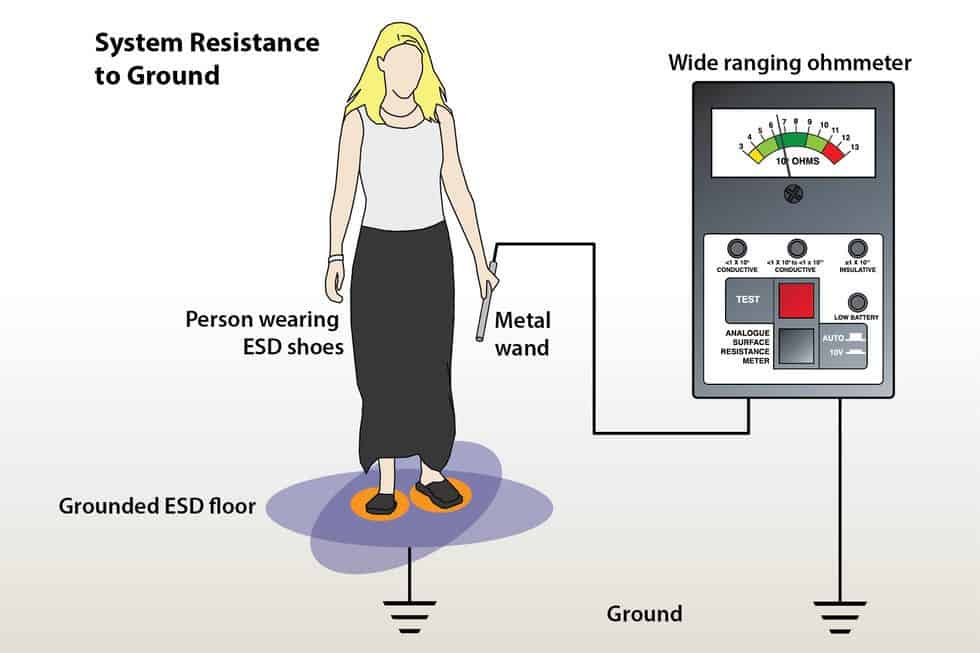
Static-dissipative floors are defined by a property called electrical resistance. Electrical resistance, measured in ohms, is a material’s ability to resist, or stop, the flow of electricity.
One of the two important parameters for describing a static control floor is resistance to ground or path to ground. In order to qualify as static dissipative, a floor must have an electrical resistance to ground that’s > 1.0 x 10E6 (one million ohms) AND ≤ 1 x 10E9 (one billion ohms).
The term “static dissipative” should not be confused with the terms “conductive,” “antistatic” or “low charge generating.”
A static-control floor can be dissipative (or conductive) and still generate charges significant enough to cause an ESD event.
Note: the secondary definition below does NOT apply to ESD flooring or flooring materials.
2) Another definition of static dissipative is: a material that can conduct an electrical charge and has an inherent resistivity range between 1 x 10E4 ohms and 1 x 10E11 ohms. Sometimes referred to as electrically dissipative.