Compliance Verification Plan
“A Compliance Verification Plan shall be established to ensure the Organization’s fulfillment of the technical requirements of the ESD Control Program Plan. Process monitoring (measurements) shall be conducted in accordance with a Compliance Verification Plan that identifies the technical requirements to be verified, the measurement limits and the frequency at which those verifications shall occur. The Compliance Verification Plan shall document the test methods and equipment used for process monitoring and measurements. If the test methods used by the Organization differ from any of the standards referenced in the document, then there must be a tailoring statement that is documented as part of the ESD Control Program Plan. Compliance verification records shall be established and maintained to provide evidence of conformity to the technical requirements.
The test equipment selected shall be capable of making the measurements defined in the Compliance Verification Plan.” (ANSI/ESD S20.20 section 7.3)
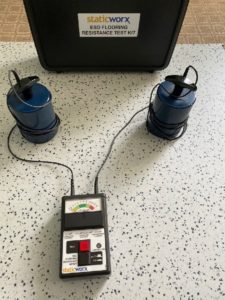
Packaging
Analog Surface Resistance Test Kit
1 Analog Surface Resistance Test Meter
1 9V Alkaline Battery
2 Shielded Test Leads
2 Five Pound Electrodes
1 Plastic Carrying Case
1 Certificate of Calibration
Features and Components
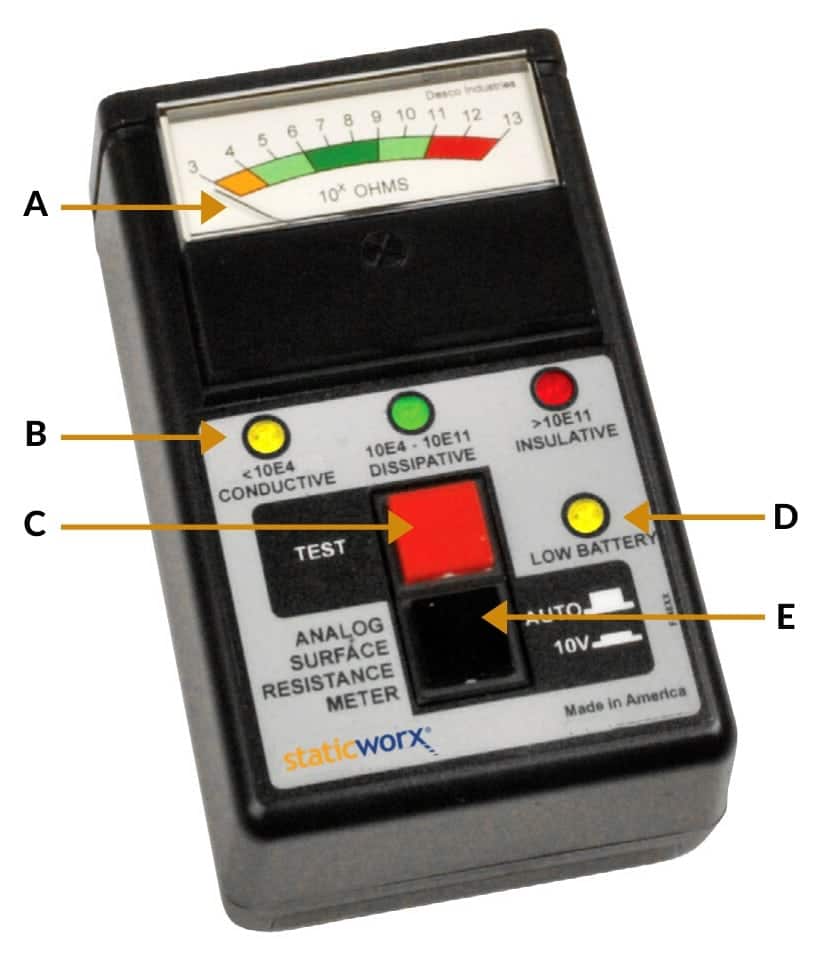
- Analog Display: Displays surface resistance measurements from 1 x 10E3 – 1 x 10E13 ohms.
- Resistance Property LEDs: Color-coded LEDs that provide quick-check resistance indicators.
- Test Button: Hold this button down to operate the Analog Surface Resistance meter.
- Low Battery LED: Illuminates when the battery power drops to 4.0V (±0.1V).
- Test Voltage Button: Test voltage will automatically switch from 10V to 100V when set to AUTO. Test voltage will stay at 10V HOLD when set to 10V.
Operation
Compliance Verification Test Procedure Guideline
The ESD Association lists test procedures and troubleshooting tips in Compliance Verification ESD TR53.
NOTE: The test kit can be used to measure RTG and RTT of shelves, garments, floor and cart worksurfaces using test procedures similar to worksurfaces and foot grounders.
Measure Worksurface Resistance to Ground (RTG)
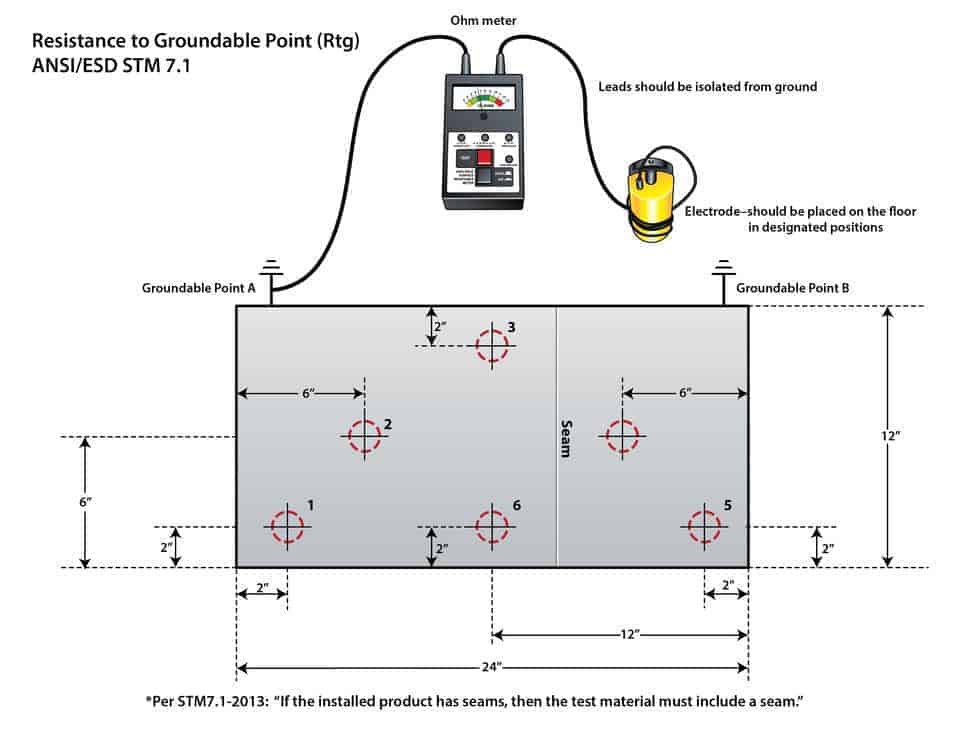
- Do not clean the surface.
- Remove all ESD sensitive items from the surface and items that might interfere with the test.
- Connect one lead banana plug to ground.
- Use one 5 pound electrode on the other test lead and place it at the center of the surface.
- Set the Test Voltage Button to AUTO. Press and hold the the TEST button until the measurement is displayed (see Figure 3).
- Perform additional measurements by placing the electrode on the most commonly used or worn areas.
CAUTION: If there is a current limiting resistor in the worksurface and the worksurface resistance is lower, the measurement will primarily be the resistance of the resistor. It is recommended to measure RTT particularly if the material color is black.
Recommended Frequency of Periodic Compliance Verification of Installed Products
The ESD Association lists test procedures and troubleshooting tips in Compliance Verification ESD TR53.
NOTE: “The frequency of periodic testing is normally specified in corporate operating procedures. …The frequency of testing is driven by the amount of risk exposure that can occur between tests. For example, what is the quantity of product handled between test periods?” (See ESD Handbook ESD TR20.20)The ESD Association lists test procedures and troubleshooting tips in Compliance Verification ESD TR53.
A Guide for Periodic Testing
TR20.20 section 5.3.1.13 Periodic Tests)
- Worksurface, Carts, Shelves – at least quarterly (see ESD TR20.20 section 5.3.1.13 Periodic Tests)
- Footwear – “Incoming inspection on a lot sampling basis should be performed for all static control footwear.” (see ESD TR20.20 section 5.3.3.4 Testing)
- Floor – “In some cases, a simple electrical resistance test with a megohmmeter may suffice. In others, a static charge generation test may be required. The frequency of testing is also a consideration. Some materials, such as floor finishes, may require more frequent testing because of their lack of permanency.” (see ESD TR20.20 section 5.3.4.15.1.4)
- Seating – “The recommended electrical resistance range for seating is less than 10E9 ohms as tested in accordance with ANSI/ESD STM 12.1. This value should be during acceptance testing, installation and periodically thereafter.” (see ESD TR20.20 section 5.3.5.3 Testing
- Garments – “ESD TR53 describes periodic verification test methods and troubleshooting for garments. The sleeve to sleeve resistance test should be made to ensure proper resistance range through the entire garment. Alternately, the garment while worn can be tested using a wrist strap tester.” (ESD Handbook ESD TR20.20-2008 section 5.3.13.3.1.7 Periodic Verification Testing)
Maintenance
The area surrounding the cable jacks at the top end of the meter should be wiped with a clean cloth moistened with alcohol to remove skin oils that will accumulate and affect the accuracy at high resistances. The frequency of cleaning will depend on usage; once a month would be a good starting point.
Per ANSI/ESD S4.1 “Clean the electrodes with a minimum 70% isopropanol-water solution.” Make sure conductive pads are dry prior to use.
The Analog Surface Resistance Meter requires little maintenance, and there are no user serviceable parts. If your unit requires service beyond cleaning the electrodes or replacing the batteries, please contact StaticWorx Customer Service on 617-923-2000.
Specifications
Resistance Ranges:
1 x 10E3 to 1 x 10E13 ohms @ 10 Volts, complies with ANSI/ESD S4.1
1 x 10E6 to 1 x 10E9 ohms @ 100 Volts, complies with ANSI/ESD S4.1
Accuracy:
±1/2 decade
Power supply:
9V alkaline battery
Operating Temperature:
41ºF to 85°F (5ºC to 30°C)
Environment Requirements:
Indoor use only at altitudes less than 6500 ft. (2km)
Maximum relative humidity of 80% up to 85°F (30°C)
Meter Dimensions:
4.5” x 2.8” x 2.1”
(11 cm x 7 cm x 5 cm)
Meter Weight:
0.5 lbs (0.2 kg)
Carrying Case Kit Dimensions:
9.5” x 12.0” x 3.5”
(24 cm x 30 cm x 9 cm)
Carrying Case Kit Weight:
12.0 lbs (5.4 kg)
External Electrode:
5 lbs (±2 oz), 2.5” in diameter complies with ANSI/ESD S4.1
What Clients are Saying

Just a quick note to let you know that the carpet tile installation started on Tuesday and everything is going silky smooth. Carpet looks great. Install is fast and easy. The system is working as it should – NICE!!
I appreciate all your help on this project. You guys have been great to deal with and customer service has been top notch.
“[ShadowFX carpet] was installed during a two-week installation window at a military base in Florida. The specifications for this RSS required ESD carpet and the product from StaticWorx integrated perfectly!”
Explore Our Testing Equipment
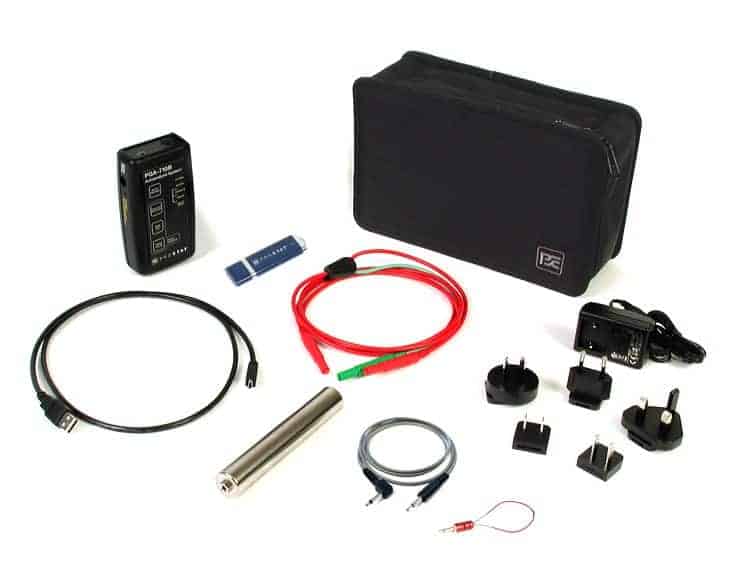
Analog Surface Resistance Test KitFrequently Asked Questions
What is the purpose of the Analog Surface Resistance Test Kit?
This portable, battery-powered meter measures surface-to-ground (RTG) and point-to-point (RTT) resistance, helping ensure that ESD-protected areas, floors, carts, garments, and other surfaces meet ANSI/ESD S20.20 standards.
When should ESD surfaces be tested?
- Before installation to qualify for inclusion in an ESD control plan
- During initial installation
- Periodically, as part of ongoing compliance verification testing per ANSI/ESD S20.20 and TR53
What does the kit include?
- Analog Surface Resistance Meter
- 9V Alkaline Battery
- 2 Shielded Test Leads
- 2 Five-Pound Electrodes
- Plastic Carrying Case
- Certificate of Calibration
How does the meter work?
The meter displays surface resistance readings from 1 x 10³ to 1 x 10¹³ ohms. It automatically selects the test voltage (10V or 100V) and uses color-coded LEDs to provide quick resistance indicators. Measurement is done by placing the electrode on the surface and pressing the test button.
How often should surfaces be tested?
- Worksurfaces, carts, and shelves: at least quarterly
- Footwear: incoming inspection on a sampling basis
- Flooring: varies based on material and usage; some finishes require more frequent testing
- Seating: resistance should be less than 10⁹ ohms during acceptance and periodically thereafter
- Garments: periodic verification per ESD TR53
How should the meter be maintained?
- Clean electrodes monthly with 70% isopropanol-water solution to remove oils
- Replace the 9V battery as needed; low battery LED will indicate when power is low
- No other user-serviceable parts; contact StaticWorx Customer Service if repairs are needed
Static-Control Education at Your Fingertips
Explore the StaticWorx Knowledge Center for technical articles, videos, and guides to help you specify, install, and maintain ESD flooring with confidence.


Ready to Eliminate Static Risk?
When your facility’s protection depends on getting it right the first time, choose
the company with an unmatched track record. We’re standing by to assist you.